Articles
Here you will find educational articles on wills, estate planning, and powers of attorney.
Use Ctrl+F (Windows) or Cmd+F (Mac) to search within this page.
Article List
Why Will?
2020-07-01 13:05
Hello all. My name is Praba Pillai. Five years ago my brother, Ganes went to bed one night and did not wake up the next morning. He was only 49. Your story may not be the same as mine but I'm sure in one chapter of your life, you or someone you know has experienced loss. Our story may differ but we can agree the challenges are many.
My brother had many belongings in his name and like many people he did not think of writing a will. I had to learn the tough realities of dealing with several branches of government, lawyers, banks and the courts. I had to also quickly learn the difference between a Letter of Administration and Probate, the Wills Act 1959, the Distribution Act 1958, and all the other legal parlance that came stacked with it.
Five years have passed and at the time of writing this piece, the transfer of title of my brother's house is still in the works. That is the tough realities of not having a will.
My motive is simple and sincere! To create awareness among Malaysians on the importance of writing a Will but without all the legal issues that go behind it and to give an affordable alternative.
That is what we do at WillsMalaysia. We offer a blueprint for a better tomorrow. It is Your Legacy, You Decide!
Cost to write a Will
2020-07-08 13:20
The cost of writing a Will in Malaysia is rather expensive (average RM 800). Most Malaysian put off this task thinking it can wait. But do you know that it is unnecessary to engage an estate planning agent, or a lawyer in order to write a Will. An individual is able to write a Will, all by themselves. All you need are two witnesses and three signatures, and the Will is acceptable under Malaysian law.
Awareness is slowly growing in Malaysia. But the general public is in the mindset that one need to engage a lawyer or an estate planning agent. you can engage them, it is your choice BUT you don't have to.
WillsMalaysia is creating awareness on the importance of writing a will and to provide an affordable alternative to all Malaysians. MyLastWillTM is a convenient, affordable and simple way to create a legal will easily and at an affordable price, all from the comfort of your home. Utilize our online wizard to innovatively create a will today! WillsMalaysia offers the most competitive prices and customizable options for all your Will and PoA documentation needs. All our products have the option to be stored in a secure physical format, to be reviewed by a lawyer, or to have unlimited updates to keep up with your busy life. No other company or lawyer beats our prices and services!
Why you need a will
2020-07-15 13:27
Many people I speak to generally understand the importance of a Will but procrastination always get the upper hand. Here are some reasons to think about:
Choose your beneficiaries
Write bequests for charity
Choose how assets are distributed
Choose trustee and executor
Set up trust for minor children
Choose guardian for minor children
Speed up distribution process
Express wishes for funeral arrangements and organ donation preferences
WillsMalaysia is creating awareness on the importance of writing a will and to provide an affordable alternative to all Malaysians. MyLastWillTM is a convenient, affordable and simple way to create a legal will easily and at an affordable price, all from the comfort of your home. Utilize our online wizard to innovatively create a will today! WillsMalaysia offers the most competitive prices and customizable options for all your Will and PoA documentation needs. All our products have the option to be stored in a secure physical format, to be reviewed by a lawyer, or to have unlimited updates to keep up with your busy life. No other company or lawyer beats our prices and services!
What happens when you die without a will?
2020-07-22 13:30
I would never wish this upon anyone as I personally know the frustration you have to go through. However it is best you have an understanding.
Your Next of Kin will have to:
Appoint Administrator
Compile Information for Assets and Documents
Carry out Self-Investigation on Debts and Assets
Obtain LA from High Court
Admitted as Administrator
Prepare Complete Estate Account
Distribute Assets
Approximate Time Until Beneficiaries Can Access Funds: Three to Five Years
WillsMalaysia is creating awareness on the importance of writing a will and to provide an affordable alternative to all Malaysians. MyLastWillTM is a convenient, affordable and simple way to create a legal will easily and at an affordable price, all from the comfort of your home. Utilize our online wizard to innovatively create a will today! WillsMalaysia offers the most competitive prices and customizable options for all your Will and PoA documentation needs. All our products have the option to be stored in a secure physical format, to be reviewed by a lawyer, or to have unlimited updates to keep up with your busy life. No other company or lawyer beats our prices and services!
What happens when you die with a will
2020-07-29 13:33
In my last article, I wrote about what happens when you die without a will. Now let's talk about what happens when you die with a will.
Your Appointed Executor will: - Administer Estate According to your Will - Apply Letter of Administration or Grant of Probate - Distribute the Estate According to your Will
Approximate Time Until Beneficiaries Can Access Funds: Three to Six Months!
It's definitely a shorter list. Am I over-simplifying it? Of course I am but these are the facts. The process is so much smoother now that your loved ones have your will in hand. There may be other issues that may arise, like all other families; jealously, rivalry, arguments and on and on. But the fact is - there is a will and the process is clear.
WillsMalaysia is creating awareness on the importance of writing a will and to provide an affordable alternative to all Malaysians. MyLastWillTM is a convenient, affordable and simple way to create a legal will easily and at an affordable price, all from the comfort of your home. Utilize our online wizard to innovatively create a will today! WillsMalaysia offers the most competitive prices and customizable options for all your Will and PoA documentation needs. All our products have the option to be stored in a secure physical format, to be reviewed by a lawyer, or to have unlimited updates to keep up with your busy life. No other company or lawyer beats our prices and services!
How to execute a will in Malaysia
2020-08-05 13:39
In this article let's look at what you need to do to execute a will left by your loved one. Usually this is the grieving stage and there could be more pressing matters to look into. Once the immediate matters have been settled then the family will have the time to look into the decedent's estate and discuss next steps. Here we give you a general idea of the steps involved.
Locate the Last Will and Testament
The first thing you'll need to do is find is the decedent's last will and testament. It is required because you have to review and understand who is the executor of the Last Will and Testament before taking further action.
Where to find the last will and testament? Here are few places where you can find the Last Will and Testament:
In the decedent's home.
In the decedent's office.
With the spouse.
With the adult children
A trusted friend
With the decedent's lawyer, the lawyer might have the original or copy of the Last Will and Testament.
In a safe deposit box, but this can be a little intricate since the bank does not grant access to anyone other than the owner itself. Please note a safe deposit box is not a recommended place to keep a will.
2. Apply to the court for a grant of Probate
When a person dies their estate would be frozen which means the decedent's bank account and assets cannot be moved or sold. So, the executor needs the grant of Probate so that he/she would be able to administer the assets of the deceased. Once the application is made, it will be considered by the High Court at a hearing. After the grant of probate is issued the executor can distribute the estate according to the Last Will and Testament.
How to apply for a grant of Probate?
The executor should provide a few forms to the court as below:
The death certificate of the Deceased
A photocopy of the executor's Identity card (IC)
Photocopy of all the beneficiaries Identity card (IC)
Copy of the Last Will and Testament
Land evidence of property ownership
Home loan statement if there is one
Bank account details of the deceased
Documentations of other assets
Documentations of other debts
Most importantly you have to apply for the grant of probate within 30 days after the Last Will and Testament has been found. The court reserves the right to request for more documents but generally the above should suffice.
3. Payoff Liabilities
The Executor should take steps to pay off the deceased's debts or taxes which were owed by the deceased. The deceased's funeral expenses should be paid off first. Before paying any other debts the Executor is entitled to claim any expenses relating to the administration of the estate.
4. Asset distribution
Once the executor has paid off the debts and taxes of the deceased, the executor can start distributing the assets according to the will. Specific property or gifts named in the will can be transferred to the beneficiaries including any donations to charity that is specified in the will. When that is done the executor must file a closing statement to the court. The executor must declare that the last wishes of the deceased have been carried out and ask the court to close the estate. Once the executor has sent out this statement, their work is complete.
5. Prepare statement of account
Lastly, the executor must file in financial data including the activity in the estate account . Close the estate bank account and send a copy of all estate activity to all the beneficiaries.
The above are steps involved to execute a Will. Depending on an individual's experience, an executor may or may not know how to deal with the courts, banks, land office and many other services. Some people may opt to appoint a lawyer to manage these activities. Our group of lawyers at WillsMalaysia have the expertise to deal with the various branches of governments and financial institutions. Our services are offered at a very reasonable and competitive price. Should you need one, feel free to Contact Us.
What are your myths for not having your last Will
2020-08-12 8:29
And the top 10 will writing myths are:
Myth 1: It's a known fact my children will get my property.
This is perhaps the most ridiculous will writing myth. While there may exist state laws that govern the way family estates are distributed upon death for those without a written Will, there may be some differences according to the law of the land.
For example, even if your spouse is the legal heir to receive your assets, but without a will, it may sometimes be a costly and complicated affair - all because there was no will in the first place. Worse, if both of you were to be involved in an accident, the consequences would be even more chaotic and a legal nightmare. Therefore, having a written Will is more advantageous in making your loved ones as legal executors and heirs of your estate.
Myth 2: I don't own many assets, so there's no need to bother about a Will.
This statement could be true, but it is only meant for today. Your will, on the other hand, extends into the far of future, and change is a constant so may be your financial environment.
For example, if you were killed at your workplace due to a careless workplace mishap, and there was a hefty insurance payout, or you happen to win a state lottery. In both instances, your net worth could obviously be worth more than your present day. In reality one exactly knows how much he or she is worth in the future.
Myth 3: I don't really care what happens to my estate, or have anyone to pass on my assets after my death.
If this is the case, think about the numerous charities or old folk homes that may benefit from your kind legacy. Otherwise the government will become the sole executor of your unnamed assets, and may use them at their own leisure and choice, which you may not have agreed to if you were alive. Hence the choice is yours, as the Will you leave behind may help someone in need very much, which is surely better than surrendering your property to the government.
Myth 4: My estate will amicably be distributed by my family members.
That is how wrong your assumption could be on will writing myths, as you may have witnessed in your own life how lovely families have split-up because of selfish or even jealous motives - all because of the inheritance issue, with each member having differing self-interest. With a Will in place, this surely will not happen, as you have set in place an execution on how to divide the wealth, however big or small it maybe, but without the family squabbles.
Myth 5: I'm still young and don't need a Will at the moment.
Death has no timeframe, as it could happen anytime, anyplace. There is nothing like the present time to take advantage of in making a Will for the future, all in preparation for eventual death. Unlike yesteryears, where making a Will can be a costly affair, today is different. With online legal Will services, one is able to get a Will within a span of 30 minutes. Hence, procrastination should not be an option.
Myth 6. Wills are an expensive affair.
That statement is further from the truth on will writing, and no longer holds water. Today there is no requirement to use a lawyer to prepare your Will. With convenient online Will services, rest assured a legal Will can be in your hands in less than 30 minutes - minus the hefty costs. In addition, with the flick of the finger, the Will can be updated at the convenience of your home computer or mobile. However, a word caution! At the least, once you have created an online legal Will, you should update your beneficiaries, or your personal, or your financial position once a year.
Myth 7: Locating the right lawyer can be tedious, or too expensive.
Obviously, there can be some truth to this, as it can sometimes be an arduous process finding the right lawyer with the right fees. But there is also no telling what other hidden charges that may exist if you were to change the Will details, like including other assets, or new family members to your Will.
All this can be solved by the easy route of seeking an online Will provider that is flexible, convenient, and a much cheaper alternative - all from the comfort of your home, minus the parking and petrol charges!
Myth 8: My Will is done.
Yes! That may be true. But did you ever think that Wills, just like any other important documents need to be updated with the current times, especially when major events occur in your life, otherwise some of your assets may not be included in the distribution list?
With an online platform that problem is easily solved, as you are allowed free updates once a year, unlike a lawyer who may charge for new updates. In addition, when you make an appointment to see a lawyer, you may be asked to name a guardian when it comes to children below the ages of 18, and you may be ill-prepared at that point - as you may need time to think it over. Rather than making another expensive trip to the lawyer, with an online service you can add that information at a later date, all from your comfortable home!
Myth 9: I can use cookie cutter Wills found perhaps in stationery shops.
Though you are entitled and may have all the right to prepare your very own Will in any form you choose, but writing your legacy in a white piece of paper may land you or your beneficiaries in a lot of trouble when the document is required to be presented in the courts. Hence, this method is definitely ill-advised.
Myth 10: I'm just afraid of all this legal jargon.
Last but not Top 10 least of will writing myths. You should have no fear of this today. As online Will services are worded in simple plain English that is both easy to understand and legal when presented in the courts. The forms are easy to fill-in, without the need for a professional and costly lawyer. All you have to do is follow through a list of easy to understand and straightforward structured questions.
So, there you go! All your 10 myths about writing a Will have been clarified. In fact, online Will services today are here to help you distribute your wealth with a peace of mind without any fear - and at the fraction of the cost, if you were to engage a lawyer.
Guess by now you should not have any excuse to not own a Will - otherwise you doing a selfish injustice, not only to yourself, but to your loved ones as well. Try it for FREE on WillsMalaysia today!
Wills Act 1959 Malaysia
2020-08-19 8:40
The Wills Act in Malaysia is applicable only to non-Muslims, since Muslim inheritance is governed under the Syariah law. However a Muslim should prepare a "Wasiat" which is equivalent of a will and appoint their "Wasi" which means an executor who would be incharge of their Wasiat.
What makes a will valid? Under the Wills Act in Malaysia,to make sure your will is valid, you'll need to: Be at least 18 years of age at the time of writing. Be of sound mind. At least two witnesses who will sign your will Have the will in writing or print and it should be signed. .
The minimum age requirement to write a will is 18 years old, except for Sabah where the legal age is 21. This is the first basic rule that we have to follow before writing a will. The person who is writing the will should be in sound mind or better said the writer should be conscious of his or her actions. The writer of the will should at least have two witnesses to make it legally binding.The witnesses must be present when you sign your will. Why? It's because if your will is contested in future, your witnesses can testify that they witnessed you sign your will. Most importantly, a beneficiary cannot be a witness according to the Wills Act 1959. If a beneficiary is also the witness, unfortunately the will's gift to that person could be declared void by a court. The rest of the will would remain in effect. Your will would be valid until it's replaced with a new one, intentionally destroyed or revoked in writing. Bear in mind, your will, will be automatically revoked if you get married, remarry or even convert to Islam. As previously stated Wills Act 1959 is only applicable for non muslims only. Finally, you must have a printed copy of your will which you have signed. Here at WillsMalaysia, we developed a smart wizard to easily create your will - all without the hassle of lawyers and extra fees. Follow the simple step by step series of questions, fill relevant details, print, and sign in front of two witnesses.
What exactly is a Last Will and Testament?
2020-08-26 10:37
What exactly is a Last Will and Testament? and do you need a lawyer to prepare one?
According to Wikipedia it's "A will or testament is a legal document that expresses a person's (testator) wishes as to how their property (estate) is to be distributed after their death and as to which person (executor) is to manage the property until its final distribution."
Now, the key to this sentence is "legal document", the question that this raises is "what makes a piece of paper a legal Last Will and Testament? "
This is defined by Malaysia Wills Act 1959 as ""will" means a declaration intended to have legal effect of the intentions of a testator with respect to his property or other matters which he desires to be carried into effect after his death and includes a testament, a codicil and an appointment by will or by writing in the nature of a will in exercise of a power and also a disposition by will or testament of the guardianship, custody and tuition of any child."
So the publicly accepted definition of a will and the legal definition of the legal paper means a written will and signed by two witnesses is all you need to complete your Last Will and Testament.
Having said the above, I'd like to caution you about good Wills and bad Wills. A bad Will is a blank form DIY will kit sold in stationery stores and online. A blank piece of paper is no way to prepare your Will.
A good Will is made up of tried and tested legal clauses that have been used by lawyers in Malaysia for decades and are known to work. Unfortunately these Wills end up with impenetrable wording that nobody except the legal industry uses; words like wheresoever and hereinafter something that you and I do not use on a daily basis, but they are known to work and so they continue to appear in Wills.
Even interactive online services like WillsMalaysia.my use these same clauses; they may not be the most intuitive expressions of a person's estate planning wishes, but they are known to work because, believe it or not, they are unambiguous. But to save you the trouble and heartache of understanding these legal jargons, we built a wizard that will go through with you a series of questions in simple and easy to understand language. Behind the scenes however our cutting edge technology compiles your inputs together and creates a legally acceptable Will. So, in essence, anyone can write their own Will and you don't need a lawyer. It is important to use established legal clauses in your Will with a structure that is known to work. That is why the interactive online services like WillsMalaysia is becoming increasingly popular.
Your Legacy of Love
2020-09-02 14:48
I read a book lately titled "Your Legacy of Love" by Gemini Adams. There is a great deal of interesting information in this book which describes the importance of leaving an emotional legacy and not just focusing on the estate planning of your material goods. At WillsMalaysia our tagline says "Your Legacy, You Decide" but it does not mean your physical accumulation of wealth only. It encompasses the emotional legacy you have collected over your lifetime. The author started an online survey asking: What would you prefer if one of your parents died: to inherit their wealth or a letter saying how much they loved you? Over 90% expressed a wish for the loving letter. The book explains that:
"our real wealth lies not in our Financial Assets, but our Emotional Assets: the stories, lessons, values, image, voice and love that makes us who we are. By sharing these in a legacy of love, we can leave our children, partners, and grandchildren a precious gift they will treasure forever, and: - reduce the suffering for our survivors."
Now you are asking - what does this have to do with me writing a Will? Most people procrastinate and come up with all kind of excuses
"I'm gone, so why should I care" or "It's obvious who will get what, I don't see why I need a Will"
Or "I still have time"
My brother was 49 when he went to bed one night and did not get up th enext morning. We all take time for granted. These are thoughtless attitudes. At a time when your family and loved ones will be struggling with your loss, the best gift you can give them from the beyond that can help them tremendously is by having a Will in place. The difference in having to administer an estate with, or without a Will is very, very different, night and day as we have explained in our previous articles. If you have a Will and have named an Executor (and guardian for your children), it can be a relatively straightforward business and your loved ones can receive their instructions and financial inheritance quickly and efficiently. If you don't have a Will, you have probably left your family with a nightmare.
In your everyday life you would unlikely show this level of "tidak apa, don't care" to anybody, certainly not for your family.
It's the right thing to do. Do not leave your loved ones with a mess to sort out. Visit WillsMalaysia now and start for FREE. And once this is in place, spend some time thinking about your emotional legacy where you can use out FREE service called MyLastWish to record or email your loving thoughts and messages to anyone. The messages will only be sent when you have passed on.
Wills in Malaysia
2020-09-09 14:04
What are wills all about and why do I need them? Wills may seem like a by-product of an era long ago, for rich people with lots of money and properties that need a complex legal document to sort out all their affairs long after they pass. Movies have dramatized the will process with films like Rain Man or The Descendants. Even books like John Grisham's The Testament popularize the myth that wills are only for the rich and famous.
This couldn't be further from reality. Truthfully, wills are legal documents designed for everybody, regardless of income or status. If you have any asset to your name, be it a house, stocks, or even a motorcycle - you should create a will!
Wills in Malaysia are defined under Section 2 of the Wills Act 1959. This act defines a will as a, "declaration intended to have legal effect of the intentions of a testator with respect to his property or other matters which he desires to be carried into effect after his death and includes a testament, a codicil and an appointment by will or by writing in the nature of a will in exercise of a power and also a disposition by will or testament of the guardianship, custody and tuition of any child".
So what does this all mean? Simply put, a will is a legal document to express what you want to happen to your estate after death. That's it.
People make wills everyday, all around the world. In Malaysia, there are certain requirements you must make sure to follow to ensure your will is valid and legal. It doesn't matter if you told someone your wishes or you write it down on a napkin somewhere. If it doesn't follow these 5 requirements, the will is invalid and doesn't hold up in court.
The 5 requirements are:
Testator (person making the will, you) must be minimum 18 years old in all states except 21 in Sabah.
Testator must be of sound mind.
testator is not a Muslim.
Will must be made in writing and signed.
Two witnesses must be present at the time of signing the will.
Note that these witnesses cannot be a beneficiary of the will or cannot be your spouse. This means you must find two people that will not receive any inheritances from you to witness you signing the will.
That's it, it's pretty simple right? Now, I know that thinking about what happens after your death is pretty morbid and sad. However, wouldn't you rather have peace of mind now knowing that if anything were to happen, your loved ones were taken care of? That's why you should check out willsmalaysia.my. We offer a 1-year free trial to check out all our products and services. The best part? You can get started on making a legal will for FREE today - all from the comfort of your home!
What is a Grant of Probate?
2020-09-16 10:13
Grant of probate? If you google, it'll say "administering the estate". For someone who is not well versed in this area you will be googling more. Let's dive in - At the point when somebody passes on and leaves property, money and assets - known as their domain - you have to figure out who gets what. To do this, you need what is known as a 'grant of representation'. This demonstrates your power to manage the bequest. What structure this takes will rely upon whether a will has been left. The Grant of Probate is a document an executor needs to obtain in order to give them authority to administer the deceased's estate.
What is a Letter of Administration (LA)?
An LA is a right given by the Court for the administration of an estate of a person who died without leaving a Will.
In what situation do we apply for a GP or LA?
When someone dies and leaves behind a valid Will, a GP will be sought.
If the person dies without a Will, an application for an LA must be made.
Who needs it?
If and when you are named in someone's Will as an executor (the individual named on the will to administer it upon the testator's death, ensuring that the wishes of the deceased are followed EXACTLY. There can be more than one named executor.) You may have to apply for probate.
This will represent as a legal document which will give you the authority to divide the property of the Testator (the person who writes a will, i.e. the deceased individual whose estate is subject to administration.) according to the instructions in the will. However, you do not always need a probate to deal with the property. As a friendly reminder, if you have been named as an executor, you do not have to act upon it if you do not want to. With this being said, an individual can be named as both executor and testator.
What is the process?
When someone passes away, their property(s) will be frozen, with that being said all their belongings will not and can not be moved, allocated, sold or even be cashed out until all the administrations complete. How will these assets be distributed? Well, for non-Muslim citizens it depends on whether a Will is done or exists. If the will exists, a grant should be made to the High Court for a Grant of Probate in Malaysia. Once all is done, the High Court will review the application at the hearing. - This process is fairly simple however it takes over three to 6 months. The documents needed for this application are -
Death certificate
Executor's identity card
Identity cards of beneficiaries
Original copy of will
Land titles/evidence of property ownership
Home loan statement (if applicable)
Bank account details of deceased
Documentation of any other assets
Documentation of any liabilities or debts
Once everything is in place, the executor can allocate the estate according to the Will, and following the legal process.
Requirements of a valid will in Malaysia
2020-09-23 10:23
This is a topic that not many will converse over the dinner table with your family, it will never be an "opening topic" or and "ice breaker" it will always be the "please don't talk about this, I am not ready" topic. For some, it will be the conversation that will help others prepare for their families future. The thing that I always wonder is what is required? What will a will cover? Well, you have heard the saying "when there is a will, there is away". Yes, you heard that right. When there is a WillsMalaysia , there Will be a way.
What is a will?
Section 2 of the Wills Act 1959 (Act 346) a will is a legal document which includes all of the testator's intentions to allocate their assets after their death.
The Wills Act 1959 in Malaysia is applicable only to non-Muslims, since Muslim inheritance is governed under the Syariah law.
What is required?
At least 18 years old (21 years for Sabah)
Be of sound mind
Have the Will signed and witnessed by at least two witnesses who will then sign in your presence and in the presence of each other
What are the inclusions in a Will?
Ideally, your Will should include all your assets:
Immovable asset: land and buildings, residential, commercial, industrial or agricultural properties/lands;
Moveable asset: cash, bank balances, shares, transferable memberships, vehicles, movable furniture, clothing, jewelry etc;
Intellectual property: copyrights, patents etc;
Trust property: property which is being held by a trustee on trust for you;
Inheritance: assets which you expect to receive in the future.
At WillsMalaysia, writing your will is an easy process. All you have to do is answer the questions, fill in any relevant details, and your will is formatted to the legal specifications, as required by the Wills Act 1959. Any questions you have about this process will be answered by our handy MyLastWillTM wizard. The will then needs to be printed and signed in front of two witnesses to be legally binding, under Malaysian law, after which it becomes immediately effective.
Is A Lawyer Necessary to write a Will?
2020-09-30 13:46
A question that we may all be wondering is if a lawyer is necessary for the process of preparing a Will.
In Malaysia, you are entitled to prepare your own will without a lawyer and there is no legal requirement to use a lawyer to make a legal will. However, in some circumstances, seeking legal advice is a good idea when preparing your Last Will and Testament and especially if there are any complicated situations that may have legal ramifications in the future; a list of these situations are detailed on our website.
Lawyers may make preparing a Legal Will a hassle or seem complicated. We believe that in many circumstances there may be no requirement to pay for any haphazard legal advice that you don't require. With provided interactive software available at WillsMalaysia it is not only possible but certainly within an individual's capabilities to prepare, review, and execute their own Legal Will.
Professional legal advice is definitely beneficial in many circumstances, and we often tell anticipated clients not to use our services. On our website we list the types of situations where we would advise individuals not to write their own Will. Here are a few:
If you are involved in a matrimonial dispute, or wish to disinherit your spouse or children.
If you have a history of mental illness, or the question of your mental capacity may be raised in objection to the statements in the Will.
If you own personal property or real estate in multiple countries.
If you are under the age of adulthood.
If you have complicated business investments (e.g. you are part owner of property or businesses where ownership may be challenged).
If you are about to be married and are preparing a Will in contemplation of that marriage.
If you have a large, complex estate and feel that you would benefit from some advice on estate planning and tax reduction.
If you have any litigation pending which involve large sums of money or where a prison term is possible.
If you think that somebody may challenge your Will in court or you have any other doubts about your situation.
If any of these situations applies to you, then don't even think about trying to prepare your own Will; you need legal advice and you need a lawyer.
These situations all contain certain complications that professional legal advisors must sort through before you can try to prepare your own Will. However, if these situations do not apply then you can consider preparing your own Will. Visit WillsMalaysia.my and Try it for FREE today!
What Is A Grant Of Probate (GP) And Letter Of Administration (LA)?
2020-10-07 23:07
So, before explaining about the Grant of Probate and Letter of Administration let's look at the important terms that we should know:
Testator
The person who writes/makes a will.
Executor
An executor is someone who would execute the Will of the decedent.
Administrator
The person who will be administering the estates of the decedent if there's no executor named.
Summary Administration
This is a legal instrument in which the executor requests to step down as an executor for the assets which are less than RM600,000.
What Is A Grant Of Probate (GP)?
A grant of probate is a grant of permission which will be issued by the High Court to the Executor so that the executor would be able to administer the Will according to the decedent's wish.
What is a Letter of Administration (LA)?
If an individual does not have a will the testator's family members have to apply for a Letter of Administration in order to access the assets,money and property of a person who died without a will.
What is the process for grant of Probate (GP)?
When an individual dies their assets are frozen. Which means the individuals assets cannot be sold or cashed until the estate administration is complete. The executor should apply for a grant of probate from the High Court so that he/she may execute the will. Once the application is made the court will consider the application during a hearing. This process will take from 3-6 months and the cost may vary. Before applying for the Grant of Probate we should make sure that the following documents are complete:
Death certificate of the decedent.
A copy of the executor's identity card (IC).
Copies of identity card of the beneficiaries.
An original copy of the Will done by the testator.
Evidence of the property.
A home loan statement if there is one.
Valid documents of the assets
Valid documents of the debts and liabilities.
After the grant of Probate is issued the executor can start distributing the estate according to the testator's wish. Simple as that.
What is the process for a Letter of Administration(LA)?
A letter of Administration is needed when an individual dies without a Will. There are 3 ways to apply for a Letter of Administration in Malaysia. The first way is to apply for the Letter of Administration through a High Court. A letter of Administration should be filed with the following documents:
Death Certificate of the decedent
Details of the applicant
List of assets of the deceased
List of possible beneficiaries
Note of any interested applicant
This process will take about 6 months to 2 years to be approved. In addition, if the estate is valued up to RM500,000 the applicant must provide two sureties. This sureties has to be a malaysian citizen who holds the same value of the testator's estate. Once the Letter of Administration is approved the administrator can transfer all the assets from their estate to their own names and distribute accordingly. The administrator will have to apply for a confirmation on the distribution as per the Distribution Act 1958.
The second way is only available for estates below RM600,000 which are qualified for administration through Amanah Raya Bhd, which is a trustee owned by the government. This might take about 4 to 6 months for estates with movable property such as cash and cars and it might take up to a year for estates that are immovable assets. Moreover, any beneficiary of the deceased may make this application. The fee is based on the value of the estate. This fee is approved by the law under the public trust corporation Act 1995 and Probate and Administration Act 1959.Here's a rough expect of the fee:
Estate ValueFee First Rm 25,0001% RM 25,001 - RM 225,0002% RM 225,001 - RM 250,0003% RM 250,001 - RM 500,0004% RM 500,000+5% Estimated Probate Fee The third way is only available to estates which include immovable assets. Application can be made under the small Estate Distribution Act 1955. The value of the immovable estate should not be more than RM2 million in order to be qualified for this option. This option does not need a lawyer to execute and it is definitely cheaper than the other alternatives. There's no fees that you have to pay to the land of office for this petition. You have to complete a Small Estate application. There are a list of documents that we have to submit to the land office:
Form A of small estate application (available in the land office itself).
Identity card of the beneficiaries (IC).
Marriage certificate of the decedent (if there's one).
Death certificate of the decedent.
Evidence of assets.
Valid copy of the land title from the land office.
Quit rent and assessment receipts.
Once the application is made there will be a hearing to resolve the estate administration this process takes about 3 months. If the court is satisfied with the evidence given, the court will issue a Letter of Administration and will order for distribution of the assets.
Here's a rough expect of the fee for this service:
Estate ValueFee RM1 - RM1000RM10 RM1001 - RM50,000RM30 Greater than RM50,0000.2% of estate value Estimated Letter of Administration Fee
Do you understand your Last Will and Testament?
2020-10-14 22:23
We discussed how simple a Last Will and Testament can be, today I thought we should talk about the language used in the document.
Most lawyers would rather you pay them to write up your will. They may give many reasons for you not to write your own will, the most common is that you may make a mistake, even if you use a technology platform like WillsMalaysia.my to write your Will.
Most online Will writing service uses a series of questions and answers to gather your details before creating a will for your review. The questions go through your personal detail, your spouse, children, your asset and many other crucial factors. Along the way you get to read and understand more about the will by using the online help, FAQs, videos and many other documentation. At the end of it, you understand more than when you started off.
Compare this to going into a lawyer's office. The lawyer may already have a template they previously used for many other clients. The lawyer may also ask some standard questions like: - Your details - Your spouse details - Your children - Executor - Guardian for minor children - Beneficiaries
Some lawyers will just ask you to complete a form for you to answer the above questions. Upon completion, the lawyer key's in your answers to the standard template and prints it out. You then walk out with the document after paying some RM 600 or so.
My argument to you is why can't you do it yourself? If you have the template can't you just "find and replace"? Maybe but usually a template is not a one size fits all. I would say you need to have control over your will. You need to take your time, understand it and go over it many times before finally signing it.
I also would argue that a will is not a one time task. There are many life changes that will result in you updating your will. The lawyer will again charge you a nominal fee to update your will. With our online service, you can update as many times as you wish for FREE.
You have the opportunity to read frequently asked questions in each section and then read your Will at the end to make sure it reflects what you really want to happen. We get questions from many people on many topics on Will that we have compiled for your reference.
Lawyers often argue that people do not have the skills, experience or even the intelligence to prepare their own Will. We would argue the opposite. We give you the tolls, the information, the system and you create your own will at your own pace and at the comfort of your own home.
We consider the process of using an interactive service and understanding what steps went into the production of the Last Will and Testament as important as the final document itself. No one prepares a will in one sitting. That is why we give you ONE YEAR to try it for FREE.
Ultimately, you should understand your Last Will and Testament, every line and every clause. The document should express exactly how you would like your estate to be distributed, and should not include any language that you do not understand. It should be plain and simple and expresses your wishes.
Who Will Be the Guardian of Your Children?
2020-10-21 22:29
There is a lot to plan when you have a child, obviously all parents want their children to have a comfortable and secure lifestyle. Therefore, above all there is paperwork to complete and file.
New parents are aware of the basics such as registering the child's birth and applying for a health card. But, the most important document that has to be written is a Will and Testament for the parents, if they do not already have one or revoke the old one with a new one.
Usually, this important document is often overlooked as parents usually procrastinate on the need of a will. Most people think that a Last Will and Testament as a document that describes the distributions of their estates after they are gone, and this is absolutely one of the most crucial aspects of this important piece of paper.
However, for new parents the challenging part is the one that names the guardian of the children. It is time to get over the superstition or fright of discussing death.
What happens if you do not have a Will?
If something were to happen to you as a parent, the other parent will be given the responsibilities of your children. Unfortunately, if something were to happen to both the parents, then everything will become arduous. It is not expected to happen but it just might. We can never predict the next second in our lives.
As parents you should have a thought on who can be the best person to take care of your children when you are no longer around. Without a Will, friends and family will apply to the family court and a judge will decide on who should be the guardian of your kids. Isn't that more horrific? The judge will not know anyone personally; it'll be decided based on their age, financial means, type of relationship or even their geographic location. How can that assure that they would take care of your children without any issues?
The battle the kids have to go through in the family court might give them mental stress which will affect them in future. There is no say in the matter if you do not have a valid Last Will and Testament.
What happens if you have a Will?
If you have a Will there will be a clause naming your choice for the guardian of your kids. Moreover, in some cases, you may also describe why you want that particular person to be your child's guardian.
There are many things to consider before you choose a guardian for your children. For example, do you want your child to move to another country? Do you want your child to live with a family member or a friend? What makes your child secure living with them? Are they financially stable, can they provide good education to your kids? And many more perspectives have to be taken into consideration.
It is a very tough decision to make, especially choosing a guardian that will replace you until your child reaches the age of 18 is not an easy thing. But if you have included all the above in your Will, this can be submitted to the family court and it will have less dispute before the guardianship is granted.
Remember you should also speak about guardianship to the guardian that you have chosen, this is to make sure the individual is aware of the guardianship.
But isn't it a pain to write my Will?
It does not have to be, if you know the proper way to write a Will.
Basically, there are three options:
You may see a lawyer, who will give you qualified legal advice. This will cost around RM500-RM1000. You will receive the best quality service, but it can be troublesome and expensive to update your Will if you have any changes. If you have a baby you are likely to make a trip to a law office.
On the other end, you can get blank Will kit forms that are sold in stationery stores. These can be the cheapest but have been criticized by many observers as they are just blank form and you have to think on how to complete the Will on your own. Even though you're allowed to do this, it's a bad idea to do so. Why? 'Because you will have to set up minor trusts, residual beneficiaries and other plans to change from time to time'. This might cause inconvenience later on since it is not a common task to a layperson. Even the slightest mistake can cause the Will to be invalidated.
Besides that, there are online tools, somewhat analogous to tax preparation software. These tools will guide you step by step on how to create a Will by asking you various types of questions. The questions will be based on family situations, your wish on distributing your assets and regarding the guardianship of your children. The superiority of these systems is that you can complete your will at home and at your convenience. Once you are done with it you may also update your documents whenever the circumstances change. Every time a change is made, you just have to print a new copy of your Will and sign it in the presence of two witnesses.
This is the easiest way to create a legal Last Will and Testament according to your convenience. Compared to the other Will writing services this would be the brisk way of having your Last Will and Testament within a matter of minutes. Visit WillsMalaysia.my and try for FREE today!
Planning for death, or just being smart?
2020-10-28 15:22
Here at WillsMalaysia, we work closely with estate planning lawyers who have decades of experience in the field of Will and Power of Attorney. We regard these documents as the most natural thing to do. In our world of WillsMalaysia, writing a will is a natural and sensible thing to do, nothing mysterious or morbid about it. We realize however not everyone thinks like the folks at WillsMalaysia and there is no wrong or right answer or any blame on anyone. It's just awareness of the importance and overcoming the procrastination of creating one. How many of you parents tried to talk to your children about writing a will? At the dining table what happens when you start the topic of your will? More often than not you get responses like "C'mon Dad, really?", "You still have time", "OMG, why are we talking about dying...".
A Will is not a once in a lifetime document. It is part of continuous financial planning that should be reviewed on a regular basis, perhaps even annually. When I prepared my will, I am in no way saying my life is coming to an end. Why is it that buying life insurance policy make sense but a will doesn't? I see no difference. It's all part of your estate planning. There is more to your legacy than a life insurance policy. And this led me to think about other preparations that should be done to protect my loved ones. One of the most important of these is an expression of your funeral wishes. Why should you document your funeral wishes? Foremost, it is a thoughtful and considerate gesture for your loved ones who would otherwise be faced with a plethora of questions and options at a time when they are least capable of dealing with them.
I'm sure you may have discussed with them in general on how you would like to be treated upon your death. Usually such discussion comes in the wake of another death where your family was closely knit with. It's human nature to avoid such discussions but we need to. Yes, we need to talk about it. We are but mortal beings. For many people it is also a difficult subject to discuss seriously and openly with their friends and family.
Assuming you had such a conversation with your family, how detail did you go? Did you talk about the overall cost, your views on who should attend, to be buried or cremated, where, what to do with the ashes, if buried what about the tombstone, the inscriptions, how about the announcement and much, much more. At WillsMalaysia, we have a FREE service called MyLastWish where you can document your funeral wishes and organ donation preference. It's just not fair to make anybody have to sit through the many questions that if you can save them the pain by putting in a little effort ahead of time. You also might find it surprising that the average funeral cost is over RM10,000. You are in a position today to say either; this is too much, or explain how you would want that money to be spent.
By putting these plans in place and giving some thought to these issues now, you are simply lifting a burden from your loved ones who will without question, have to deal with these issues in the future without a choice. Nobody is immortal and many of us will definitely leave loved ones behind. You can grant a critical service to your loved ones by helping them ahead of time by giving some thought to these things today. Take a look at the services at WillsMalaysia.my and have everything organized today.
The importance of choosing an Executor
2020-11-04 15:51
Let's talk about the character traits that you need to look for when you are choosing an Executor for your estate. This person needs to take on the role of an accountant for your estate. They then need to gather up the estate and distribute it according to your wishes. The most obvious trait you will be looking for in your Executor is a person with a head for numbers and one who is organized.
Your Executor will have to keep a detailed record of your entire estate, and also a record of how it was distributed. Keeping notes on paper or a diary won't be enough. They are accountable to the beneficiaries and will need to provide receipts on request. Your Executor may be required to hold some of your estate in a trust fund. This means that the need to be good with money and have a sense of how money should and should not be invested. There are so many examples of how this can go wrong, for example, a trustee can steal money from a child's trust fund. And sometimes the mis-use of a trust-fund can just be an alleged misappropriation rather than an outright theft.
It is important to bear in mind that your Executor may have access to sums of money through your estate that they wouldn't see on a normal day. Greed can take over your Executor and money can just go missing.
So who should you choose? It is a very personal decision, but the most important trait of all is one whom you can trust. Your entire estate will be handed to that person for distribution as documented in your will. Will this person see it through without taking an unfair fee along the way? Can you trust him or her up to the job?
Most people would appoint their spouse or older children. Your spouse or children can become the Executor even though they are named as beneficiaries. They only cannot sign your will as a witness.
Think carefully and decide.
When to update your Last Will and Testament
2020-11-11 16:41
In Malaysia, more than 70% of adults do not have a Last Will in place, but of those who do, most are not updated on a regular basis. It is a dangerous misconception to think that once you have a Last Will in place, it will serve you for the rest of your life. I've mentioned this several times before, a will is not a one-time task.
I meet many people and I usually tell them I am associated with the WillsMalaysia websites and it is just frightening how often I hear statements like "Oh, I have my Last Will written already, it was prepared before Jason and Alison were born". In other words, the Last Will is obsolete because it doesn't include critical information about minor trusts and guardians for the children. If only they know this, sad. The whole distribution of property section is almost useless if it doesn't include the minor children as alternate beneficiaries.
We feel that at a minimum the Last Will has to be updated at every life event. What is a life event? Marriage, divorce, children, death and many more critical events. What if your beneficiaries pre-deceases you or your first choice plan cannot be followed. There could be changes in your business life or your financial situation. Your Executor's situation or the value of your assets might have changed. How about if you bought or sold a property. There could be many reasons to update the Last Will. At WillsMalaysia we highly recommend reviewing your Last Will at least once a year. Maybe on your birthday or on New Year's Day. You choose but choose a day.
If you are one of those who paid a lawyer hundreds of Ringgit to prepare your Last Will, the question I ask you is for how long that is valid? A few months or a few years? But it could last less than a day if any of these life events happen to you as you walk out of the lawyer's office. My brother died at a young age of 49, he was to be my Executor. Realistically, your Last Will is going to be a useful expression of your wishes for several months, maybe a couple of years to be exact.
Then come the question how do you update your Last Will? The two common mistakes we came across and which is a big no is to write on the Last Will. Don't do it, even if the change is a small one; it will be impossible to know who made the update and when, and it is an invitation to be challenged in court.
The second is preparing a codicil or an addendum which is a piece of paper listing the amendments that is then attached to the Will. Again this is an invitation to be challenged in court.
With today's technology, and certainly if you use an online interactive service, you should just create a brand new Will. You can usually just log into your account, make the change that you need, print a new version, sign it in the presence of witnesses and then destroy your old Will. You will then have an up-to-date legal Last Will and Testament. That's exactly what we offer at WillsMalaysia and all updates are FREE.
Imagine if you have to walk to your lawyer's office each time there is a life event. Well while I'm sure your lawyer will be happy to entertain you but I bet it will not be for free.
I'm not ready to write my Will
2020-11-18 21:23
Of course you are not. A will makes life so much easier, after your passing. It's true, it has no benefit to you while you're living. Just like a life insurance policy, it remains dormant until you are dead. A will is basically a document that insists you in making several decisions that could be life changing to your loved ones.
When you die, you leave behind your legacy to the ones you love. Given that it is your legacy so it's best you have a say in it. It's your legacy, you decide! A will makes the transition of your legacy a smooth one. But are you ready to write a will? Many people procrastinate or think they are not ready. There is no good time to write a will but we know you need to write one. Give your family a blueprint for a better tomorrow. Basically, a will is the document which states how you want your assets to be distributed among my beneficiaries when you die. Every decision taken should be made in sound mind. This is to avoid any legal challenge in court.
As I've said before, writing a will is not a once in a lifetime effort. It is a continuous effort. There are many life changes that can happen after you write your first will. So to keep it updated is important. Think of it like maintaining your car. Oil change and service is crucial to ensure it is ready to drive whenever you want. So is keeping your will updated so it is active and current at the crucial point for your loved ones. May not be the best of analogies but I think you get my point.
Here at WillsMalaysia, we do not charge you for subsequent updates. You may make as many changes as you wish. To ensure your will is valid and legal, all you need to do is to sign it in front of two witnesses. Imagine having to go to a lawyer each time you want to update your will! We also encourage people to review their will on an annual basis. You may just log into the account and make changes on your Last Will and testament. This system is user friendly whereby you do not have to depend on someone to update your last will and testament. Some of our clients have done this dozens of times.
Your circumstances will always change from time to time. It might be anything concerning the lives of your beneficiaries, Executors and Guardians. That is why we encourage you to make a Will before it is too late. So, write a will before it is too late.
Writing a Will is not brain surgery
2020-11-25 9:00
I really get worked up each time I hear lawyers advising people not to write their own will. Writing a will is not brain surgery, for crying out loud! Yes it is a legal document but you do not need a lawyer. Let's get real for a minute. It is your will, don't you want to have control over it? This is what you are going to leave behind for your loved ones. Don't you want them to have a smooth experience? Losing you is hard enough but imagine having to jump through all the legal hoops to get your estate distributed can be quite an adventure on its own; not a fun one, believe me!
You write your own will, expressing how you would like your possessions to be distributed after you die. It may also include naming the person that you wish to look after your children if both you and the other parent were to both die at the same time. If you sign this document in the presence of two witnesses who then both sign, you have created a legal Last Will and Testament. It is not brain surgery; it is simply an expression of your wishes for your estate.
Yes I understand your case may not be the same as others. Things can of course get complicated if you have more difficult things to take care of. If you need to set up a trust for a child with special needs, you may have many business interests, or property held in different countries, maybe if you have young children from previous marriages...in these cases you may need legal advice. But many people do not require legal advice to prepare their own Will, because writing a Will is not necessarily a difficult task.
Most interactive online services are prepared by lawyers who are very experienced in estate planning. They even have a service that lets you have your Will reviewed by a lawyer once it is completed. There are many arguments from lawyers on various reasons on why you should not prepare your own will. As though it is a definite challenge by your own family should you prepare your own will. The funny thing is, according to my circle of lawyers, the wills commonly challenged in court are prepared by lawyers.
So enough with the scaremongering analogies. Preparing your own Will isn't like performing your own brain surgery, walking on the moon or splitting the atom. It's simply writing down what you want to happen to your things after you've died, in a clear and unambiguous way. So don't be afraid of it.
There you have it, writing your will is not brain surgery. There are many other things much tougher. So enough with the fear tactics. Instead of listening to a lawyer, why don't you try Google instead. Just do some research yourself. Here at WillsMalaysia we offer a very comprehensive service to writing a will online. We offer more than just writing a will. Check us out. WillMalaysia.my
Why document your Funeral Wishes
2020-12-02 9:00
Documenting your funeral wishes is necessary and important for several reasons. Your loved ones will be able to carry out your exact wishes you desired. They also can budget for the funeral service, and most of all - it gives your family peace of mind, knowing they are honoring you as you wished.
Here at WillsMalaysia.my, our product MyLastWishTM takes care of all the minute details, providing you assurance and ease knowing your wishes will be appropriately dictated and communicated to your family after your passing. Common details to include in your MyLastWishTM include preferences like burial or cremation ceremonies, open or closed caskets, desire for a specific location for ashes, and choices regarding organ donations. There are endless ways your funeral service may go; it is better to ensure it goes the way you want, rather than leaving this significant ceremony up to chance.
https://youtu.be/-r-Q8M_5c8g
The MyLastWishTM wizard asks all the relevant questions regarding your funeral service, and you may answer as many, or as little questions as you may wish. By making this significant decision now, you will be happy knowing your final wishes will be relayed to your loved ones.
The Wizard also covers your organ donation preferences. You may at your discretion elect to donate your whole body, parts of your body, or not at all.
As with all WillsMalaysia services, unlimited changes to your MyLastWishTM is completely free of charge. MyLastWishTM is the only service that can ensure your final thoughts and wishes will be communicated to your loved ones.
Join for FREE right now, and you can use the MyDigiSafeTM, MyLastMessageTM and MyLastWishTM services free of charge for 1 year.
Do you have a will?
2020-12-09 9:00
Lately we received quite a number of emails on what people go through when their loved one die with or without a will. We have written on this topic before but thought we can summarize it here again.
Let's first explore if you do not leave behind a will and what your loved ones will have to go through.
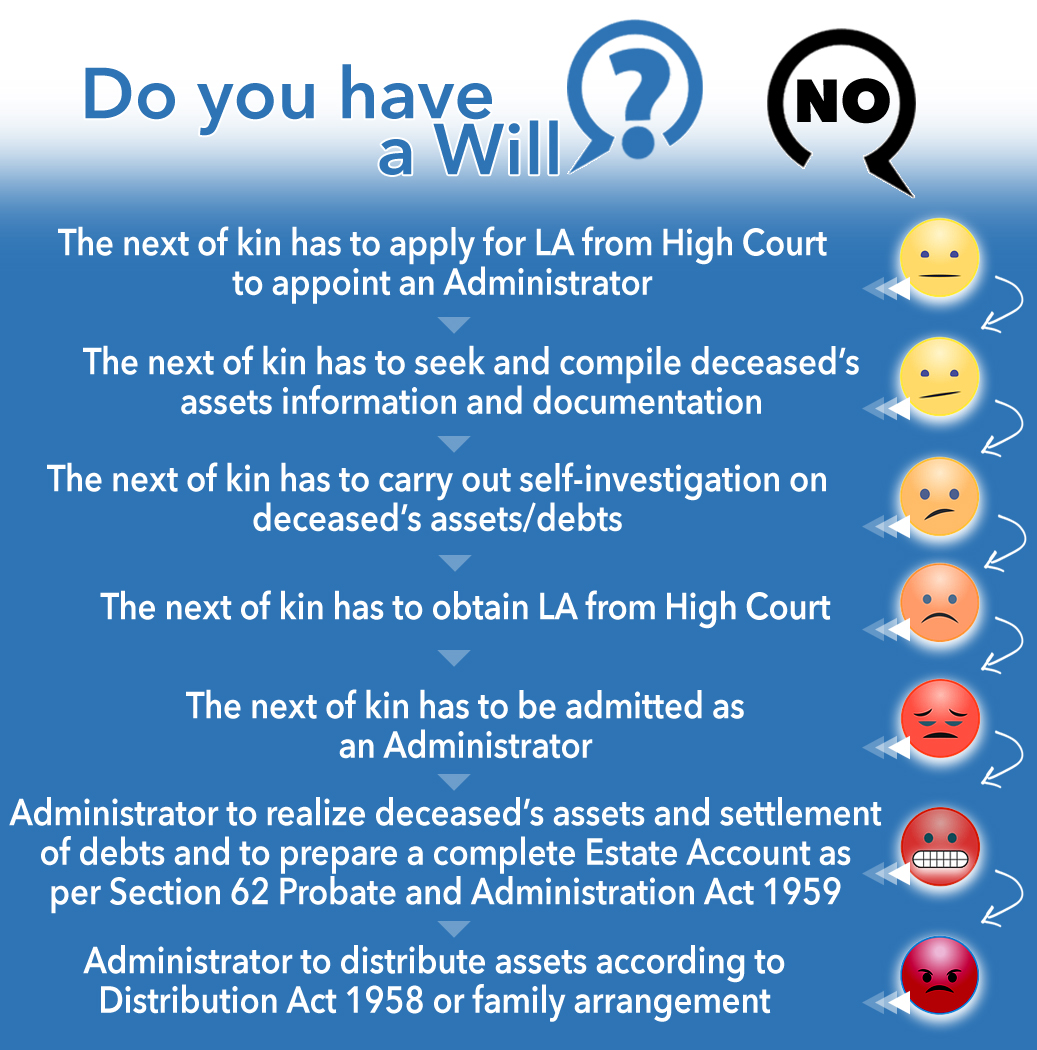
Do you have a will? No The next of kin has to apply for LA from High Court to appoint an Administrator The next of kin has to seek and compile deceased's assets information and documentation The next of kin has to carry out self-investigation on deceased's assets/debts The next of kin has to obtain LA from High Court The next of kin has to be admitted as an Administrator Administrator to realize deceased's assets and settlement of debts and to prepare a complete Estate Account as per Section 62 Probate and Administration Act 1959 Administrator to distribute assets according to Distribution Act 1958 or family arrangement
Now let's see what happens when you leave a will behind for your loved ones.
Do you have a will? Yes Your appointed Executor will administer the estate according to your Will Your appointed Executor will apply Letter of Administration or Grant of Probate Your appointed Executor to distribute the estate according to your Will
What exactly does an Executor do?
2021-01-06 9:00
What is an executor? Now, the meaning of Executor (personal representative) "A person or institution appointed by a testator (a person who has made a will or given a legacy) to carry out the terms of their will."
The chosen Executor(s) will need to bear in mind, whatever the Will states, he/she will need to carry them out according to the will. This is important, because your will is your last wish. Once you choose you executor it is important to seek their consent. Not everyone can carry the weight of a person who has died, the responsibility holds a big part. Why? Let me explain..
These are the most commonly required steps an executor should do:
* Locating your will The executor must first locate the original and most recent will that the Testator left. By this time, the executor must know where it is located, if they do not, he/she will need to search for it with the help of the deceased's family.. Most people believe the best place to keep a will is at the safe deposit box in a bank. But remember, the first thing the bank does when they come to know a client has deceased is to freeze all their accounts, including the safe deposit box. Imagine heading to the bank and asking them to open a safe deposit box that does not belong to the executor and now having a legal document to proof otherwise. We highly recommend safekeeping the will with your chosen executor themself, your spouse or in a safe in the house.
Some people document their funeral wishes in the will itself. Remember the executor's job is the deal with your estate, not with your body. We do not recommend including your funeral wishes into your will instead document it in a separate document and give it to your family when the time is right. Moreover the family will attend to the needs of the funeral first before moving on to the will. now that the funeral is taken care of and the will has been located, let's move on to the next step.
* Applying to the court for a grant of probate The next step is to apply to probate the Will so that the assets can be dealt with legally. This may require legal assistance. A will search might need to be done with any government body in order to verify that the will submitted is the updated will. The application for Grant of Probate should be applied to the High Court. The entire process will roughly take from about three to 6 months depending on the size of the estate. Once the probate is granted and extracted, the executor can collect all the deceased's assets into his/her possession to first settle all the deceased's debts and liabilities. This will grant the executor(s) the legal right to administer the estate. * Calling in your assets The executor must be responsible for getting all the right information of the will, such as stocks, bonds, or money market investments; real estate; direct investments; or even collectibles like art. This will be accounted for, along with transferring the assets to the correct party or parties. * Paying off your liabilities All prospective creditors must be given an opportunity to stake a claim on the estate. The Executor must advertise for anybody who may have a claim against the estate. Creditors with a valid claim can recover their debt at any time, even after the estate has been distributed to the beneficiaries.
The Executor is accountable to the beneficiaries for the assets of the deceased. It is therefore vital that accurate records are maintained when dealing with all debts, expenses, taxes, and the distribution of the estate. The executor must have accurate records of bills and documents. It is vital to have all the information up to date when dealing with debts, expenses, taxes, and distribution of the estate. They need to maintain it throughout the process before proceeding with the Will hearing for the property and assets to be distributed.
If the testator has left any debts or taxes, it is the duty of the executor to ensure everything is paid off. When people agree to be an executor, they think it will be in years to come before they have any work. No, this is not true, doing the required work means you will have to work immediately. "The future is uncertain, and the end is always near". I do agree with the wise words from Jim Morrison, your responsibility as an executor can be at any time.
* Distributing your assets according to your will From the time of death of the testator, their assets will be frozen until the Grant ofProbate has been safely received at the hands of the executor. Once it is acknowledged, the executor has the legal authority to administer the estate accordingly, however, any property or assets held mutually between a married couple, it can automatically be passed on to the living spouse upon the presentation of the Death certificate. The executor must now notify everyone who has an interest in a property or assets. When an executor is appointed, they act as your trustee holding your assets until it is fully distributed. Your trustee will be subjected to the responsibility by the Trustee Act 1949.
When your executor takes charge of your assets, he will also take the role of a trustee holding your assets on trust for your beneficiaries until the assets are fully distributed.
As you can see, the responsibilities of an executor is crucial. they have to be sharp, good in numbers and strict in dealing with authorities and the likes.
If you have someone in mind that you would like to be your executor, and they have not been reliable, for instance, have never filed their own taxes, and do not show up when you need them too, you probably need to find someone else. Before choosing the right executor(s) you would need to appoint someone who is skilled and trustworthy because picking the right executor can ensure efficiency, effectiveness, and accuracy on how you would want to distribute your assets. The testator can choose anyone, usually a lawyer or accountant however family member(s) and even close friends can be named as executors. As a testator, you can choose one of four adults (maximum) who are 21 years old and above and no prior felony charges. Bear in mind, when choosing an executor, they just need to be trustworthy and capable.
Use our smart wizard to help you create your will and along the way you will learn a lot about choosing an executor. Visit WillsMalaysia and try for FREE today!
Who can be a beneficiary in your Will?
2021-01-13 9:00
When writing your Will, one of the important consideration is choosing your beneficiary or beneficiaries.
A Last Will & Testament is a vital tool which helps protect your family while distributing your assets based on your priorities. From passing down your house to selecting a guardian to look after your kids, a Will makes your wishes come true after you pass.
To those wondering what a beneficiary of a Will is: well, this refers to a person whom you choose to inherit your assets when you die which may include your properties, cars, cash and other belongings.
However, when it comes to deciding who to choose as a beneficiary, it can be a difficult question, especially when you are not sure who can be included in your Will.
It is important to note that this is a different question to "Who must be included in my Will?". We will address this in a future post.
In general, anybody can be a beneficiary but there are some exceptions.
Here is what you need to know before choosing your beneficiaries:
1 The beneficiary must not be responsible for your death
A Will allows you to do great things with your legacy, according to your wishes. Therefore, it goes without saying that a major restriction for a beneficiary is that they cannot be someone who is criminally responsible for your death!
2 A beneficiary cannot be a witness to the signing of the Will
A witness is someone who is present during the signing of your Will.
In Malaysia, in order to ensure your Will is valid, there must be at least 2 witnesses who are above the age of 21.
Therefore, it makes sense that someone who will materially benefit from the contents of your Will cannot be a witness, in some jurisdictions even the spouse of a witness.
3 A beneficiary can be an Executor of the Will
An Executor is someone who you have selected to fulfill your wishes and ensure your assets are distributed. The difference between an Executor and a witness is that the Executor can also be a beneficiary in your Will. This means you may even appoint your child to be an Executor of your Will.
4 A beneficiary can be a person or an organization anywhere in the world
As mentioned, you are free to leave your possessions to any person or organization from different parts of the world. In terms of family, you can distribute your assets however you like.
A certain family member can have your properties while another may be given your cash. It all depends on who you feel will be responsible for your belongings and will honour your wishes.
Even if any of your family members are not living in the same country as you, you are still able to choose them as a beneficiary in your Will.
Your child can also be a beneficiary even if they are still minor. This would just mean their inheritance will be held in a trust until they become adults or reach a certain age specified by you in the terms of trust, to receive their full inheritance.
On the other hand, if you have a sum of money or a particular asset that you wish to leave to an organization, you can! This list includes charities that you support, schools or even religious institutions which are not restricted by location.
Therefore, organizations you choose can also be on the other side of the world and it will not be an issue.
5 A pet cannot be named a beneficiary in your Will
Even if you love your pets and think of them as family, unfortunately, pets are regarded as your property.
So you are free to set up a pet trust which enables the carer of your pets to access funds to look after them which may include medical bills, food and pet care items.
In most cases, individuals designate a certain sum to a person that will look after their pets, with the understanding that they will use the funds to care for the pets.
Choosing beneficiaries for your Will is an individual decision. It should reflect who you want to leave your assets behind too. As long as you have taken care of your primary responsibilities, your estate can be divided to anyone or any organization. Therefore, as always at WillsMalaysia, we encourage people to be creative with their legacy as it is an opportunity to do great things. If you wish to know more about writing Wills, be sure to catch our future blog posts.
Living Wills in Malaysia
2021-01-20 9:00
Have you ever thought about what would happen if you were stricken with some incurable or insufferable disease that would inevitably drag out the last years of your life? Of course not, most of us don't dwell in the despair and dreadful thoughts that are end-of-life planning. However, despite our denial of these possibilities, these are very real situations that happen to people everyday around the world. In 2020 in Malaysia alone, there were over 48 000 cases of cancer diagnosed this year. And while you might think living wills and planning is something designated for elderly, those with children, or otherwise unhealthy and/or vulnerable people, millennials and young people are just in as much danger as the rest of the population. The number of patients aged 18 to 40 hospitalized in Malaysia have doubled in recent times. 30% of Malaysians from the ages of 20 to 29 are obese, 26% have high cholesterol, and 13% have hypertension. Our health as a nation is worsening, and it's not getting better anytime soon. Regardless of your age, chances are you are at high risk of worsening health down the road. The time is now to start planning for the unfortunate event should you be bed-ridden or stricken with a disease that leaves you suffering endlessly and unnecessarily. Chances are while you're reading this, you know someone that has one, or a combination of all of the above medical afflictions. You yourself might be suffering from poor health. You can't control what happens in the future to your body, but at least take the time today to control how you are going to respond to it.
By planning for a living will, you take charge of the medical decisions inevitably inflicted onto you and ensure you aren't suffering needlessly. Do you want to end up like the 75-year old man and patient stuck in a hospital bed, unable to move and condemned to a life of having nurses change his clothes and watch him for bedsores? Avoid the long-drawn out, and painful death that prolongs the inevitable by creating a living will today. While situations like these seem unlikely, the fact of the matter is when it does it happen, it's long and painful and insufferable. In cases of which you might be terminally ill, facing imminent death, afflicted with a severe and irreversible condition which impairs your consciousness, or in a situation where life support would be extended or withdrawn for terminal illnesses with no recourse. It's a scary but very real situation many people face in Malaysia on a daily basis. The only way to protect yourself from suffering needlessly in a hospital bed for years on end with no quality of life is to create a living will today. This simple document is legally binding and provides clear directives to carry out your wishes for medical professionals and your loved ones alike.
What does a living will do? It gives you the power to determine how you want to end your suffering before you lose your decision-making abilities. The living will provides medical professionals like your doctors and nurses guidelines on how to implement your wishes. The living will can even be as detailed to give doctors instructions on specific events, such as in a case of rapidly deteriorating health with little chances of survival, you could dictate a provision of not wanting to be resuscitated. Living wills ensure there is no confusion over your wishes, and protects your peace of mind. Instead of leaving the difficult decision over what to do with your body to strangers, you are in charge of ensuring your quality of life. Why put loved ones like family members to make heart-wrenching decisions over your life during times of intense stress during medical emergencies? By thinking and planning how you want to deal with these very real situations now, when you are lucid and of a clear-mind, you ensure that rushed and impractical decisions aren't being made in the heat of the moment. It avoids conflicts among family members, confusion over doctors, and above all, ensures your wishes are being carried out.
In addition to providing clarity for medical decisions, living wills also have provisions for financial assets and living arrangements. Lots of elderly people over the age of 65 have reported being financially abused by those closest to them. Protect your money and ensure you will have the resources to take care of yourself when the time comes. Additionally, you may have a wish to die in a specific place, like your home. It's certainly much more comforting and sentimental than a sterile hospital room. Ensure your wishes are respected with a living will.
If 2020 has taught us anything, it's that you never know when your time is up. Even worse, you might end up in an unfortunate situation wherein you are stuck on a ventilator for weeks or months, with no end in sight and no guarantee of consciousness or quality of life at the end of it. A living will is the only recognized, legally binding document in Malaysia that ensures and protects your wishes on how decisions on your behalf should be carried out. Don't put your quality of life in the hands of someone else. Create a living will and have peace of mind should the unfortunate occur.
This article was written to give you an understanding of what a living will is. However in Malaysia, the law is not too clear about living will, as is in other developed nations. The following three articles reported in TheStar explains the ongoing debate.
https://www.thestar.com.my/news/nation/2014/12/08/patients-can-also-write-a-living-will-on-how-they-wish-to-be-treated
https://www.thestar.com.my/news/nation/2014/12/08/living-will-for-the-terminally-ill-amd-gives-patients-greater-say-on-how-they-wish-to-die/
https://www.thestar.com.my/news/nation/2014/12/08/group-calls-for-guidelines-on-issuance-of-directive
The good news is we can use a Power of Attorney for Healthcare where you can authorize an individual to make decisions on your behalf. To learn more please visit: https://willsmalaysia.my/power-of-attorney
Try WillsMalaysia for free today!
What is the Price of a Will?
2021-08-11 6:26
I think the more relevant question is what is the price of not having a will? Death is imminent, whether you like it or not. It is a subject of taboo in many cultures. But we can't go on our lives living in fear of death but rather accept it and plan for it.
Would you rather pass on knowing you have planned to the best of your ability the distribution of your assets or would you rather your loved ones squabble over them? We assume the worst that they will fight and squabble over your assets but you will never know.
Over the years you have worked hard, build a family, owned many possessions and created some wealth. These are all your legacy. What better way than to define how your legacy lives on by you taking ownership of its destiny.
What is the price of a will? Peace.
What is the price of a will? Resolved.
What is the price of a will? Clarity.
Give your loved ones the peace of mind knowing you have spent time thinking about what you are leaving behind and who you are leaving it to. Let them know you have also considered legal guardians for your young children should you and your spouse demise that the same time. You may also include any charitable donation or even a trust for your pet.
You can achieve all these and more by using our friendly services at WillsMalaysia.my
What if I get divorced?
2021-08-18 12:14
How does your marriage or divorce affect the validity of your will? That's a great question. Your will is automatically revoked when you get married or remarried. A divorce however does not affect the validity of a will. You need to create a new will in such circumstances.
Our advice at WillsMalaysia is that writing a will is not a one-time task. It is a lifetime task. Consider all the life events that takes place in your life. Marriage or divorce is an example of life events. Other life event examples includes having children, your beneficiary dies, changes in your business life or your financial situation, your executor situation changed, you bought or sold a property and many other events that may warrant you to update your will.
If you are one of those who paid a lawyer thousands of ringgit to write your will, then you will have to update the will for each life event changes. That is going to be costly. At WillsMalaysia however, all subsequent updates to your will is free of charge, as long as your membership is active.
It's your legacy, you decide!
Inheritance
2021-08-25 6:12
What is inheritance? Well simply put, it is what you inherit from someone usually a loved one through a bequest. In other words, you now own what use to be someone else's. Wikipedia defines inheritance as "Inheritance is the practice of passing on private property, titles, debts, entitlements, privileges, rights, and obligations upon the death of an individual".
Lately I read an article by The Guardian entitled "'Inheritance is a problem': parents on what they will leave to their children". You see back in the days of my parents, the elderly work hard, toil and save in hopes of one day passing their wealth on to their children. This may still be the practice today is come cultures, especially in the eastern culture. But some parents nowadays are feeling a little different, and I think they could be on to something. You work hard, play by the rules and build an empire. The question is why don't you enjoy it? Maybe not 100% of it but at least 90% of it? Why do parents feel guilty that they are eating into their children's share? Let's take a step back. What share? How are your children automatically entitled to a share? It is your legacy, you decide. There is no obligation for you to give anything to anyone.
The article was interesting that it says when we give something to someone who did not work for it, then the value is lost. They do not appreciate it as much as you did. Easy come, easy go they say. Should this be your legacy? Maybe we leave them "some" to motivate them to work hard. Or help them to start a business or some down payment to buy a house. Why don't you want them to work as hard as you did? Unless you are leaving them your inheritance, then there is some food for thought.
An individual in the article says "It's about mine and my wife's quality of life and making sure we have a good life to do the things we want to do, and support the causes we want to." I find this to be quite fascinating to think about. It's your life, you deserve it.
Opportunistic Siblings
2021-09-08 19:59
Lately I read an article about a man who took care of his father for 23 years. His father then gave him $20,000 and a vehicle. He has concerns his opportunistic siblings might contest it. The caring society in Malaysia takes care of our elderly. This is our culture, it can be quite challenging at times but the care and love they gave us was unparalleled and we want to give them the same. However if you have siblings then the care could be different in both positive and negative ways. Sometimes parents prefer to live in one child's house as compared to others. This may cause some sibling rivalry. But as you know, family is a very complicated matter. No two families are the same.
Back to the article. In this case the man was gifted by his father while he was still alive. The money was deposited into an account under the son's name and the car was also transferred to the son's name. Could it be contested upon the father's death? Probably yes amongst the family but it will not stand up in court. And it need not be in the father's will.
Gifts made during the donor's lifetime are more difficult to contest than wills, as the article's response states. Gifts are not subject to probate, a will, or its provisions for the division of an estate. The donor must have the mental capacity to have made the gift, but it is very difficult to contest such capacity after the fact.
If you are in a similar situation, you have nothing to worry about, legally. How as I mentioned, family can be a complicated thing. If you have reason to believe your siblings will contest it, then get it in writing now. It's cleaner that way.
Validity of a Will
2021-10-25 23:41
A will is known as "Last Will and Testament" basically because it is your last. As soon as you write a new will, sign it in front of two witnesses and date it, it becomes your Last Will and Testament. It overrides any other will you may have. Your will is automatically revoked if you marry or remarry. And in Malaysia if you convert to Islam it is automatically revoked as well.
You may appoint any adult, 18 years or older to be your executor. You can also appoint up to 4 executors to jointly administer your estate. Your executor can also be your beneficiaries. For example if you are leaving all your assets to your spouse and children, then you may name your spouse as the executor.
What does the executor do? Basically the role of the executor is to ensure the wishes in your will is followed through. This includes:
Locating your will
Applying for a grant of probate
Inventory of your assets
Paying off any debts
Distribution of assets per your will
Prepare a statement of account
What happens if you miss out certain assets? Not to worry, your will should include a residuary clause which deals with distribution of asset not mention in the will.
People have asked if a will can be challenged. It may be challenged in court on the grounds that it may have been altered, you were not of sound mind when you made the will or it was not witnessed. So it is important to ensure your will is witnessed and signed and a copy be given to your executor.
As far as witnesses are concerned, they can be any adult you chose as long as they are not a beneficiary of your will. Stamping and registration of a will is not required under Wills Act 1959.
The Pandemic and Will writing
2021-11-02 0:47
The Covid-19 pandemic has produced a rise in estate planning, but not a large enough rise as we were expecting. Most Malaysians still do not have a last will and testament. Many believe that they don't have enough in assets like money or properties to warrant a will, or that their savings will automatically go to their next of kin. Both assumptions are incorrect.
There is not enough data and research in Malaysia to conclude a study and report on will behaviour. However there were many studies done in North America that we can review.
Surveys conducted by a number of online services found that 32% of young people ages 18 to 34 said they got a will because of Covid-19. Moreover, 21% of that age group also drew up a will specifically because they or someone they knew had Covid-19.
Of those who do have a will, just over a quarter, or 26%, got one because they were fearful of serious illness or death related to Covid-19.
However, the majority of Americans and Canadians still do not have a will, just like Malaysians.
The survey found that 62% don't have a will and, of those who do, 12% created them in the past 12 months - and 44%, in the last three years.
Many people think that they don't have enough in assets to warrant a will, or that their money will automatically go to their next of kin. Both assumptions are factually wrong. It is crucial to get the facts and put planning in place to protect those you love and ensure that you are the one to decide how your possessions and money will be distributed. It's your legacy, you decide.
Fact #1: If you die without a will, the Distribution Act 1958 writes one for you. So, if you don't want the wrong person to have ownership of your estate, write up a will now, while you are of sound mind and good health. It's your legacy, you decide.
Fact #2: You are never too young to have a will. Wills Act 1949 says a non-Muslim 18 years and older can write their own will. It would be nice to live a long life but there is always the chance that you may not. Unless you have a will, your loved ones may be left with a mess that they will have to unravel. If you own anything, anything at all and if you are 18 and older, you should have a will in place. It's your legacy, you decide.
Fact #3: A verbal agreement cannot be enforced legally. Suppose you let everyone know that you would like your mother to take care of your children, but then what if your mother-in-law decides she wants them as well? Without a will, the decision of who gets the children is up to the court. Choose your guardians wisely. It's your legacy, you decide.
Fact #4: Decisions are made according to the most recent, updated will. Life Insurance and EPF beneficiaries are not covered under the Wills Act 1959. Remember to update the beneficiaries separately. It's your legacy, you decide.
Fact #5: You do not need a lawyer to write a will. Here at WillsMalaysia we offer a comprehensive service at a fraction of the cost. You have nothing to lose so check it out. It's your legacy, you decide.
Communicate your estate plans during this Holiday gatherings
2021-12-13 0:57
My wife and I have been discussing about what do we leave behind for our children. We have a house in Balik Pulau Penang that we use as a getaway from the busy city life. Most of the times it is on Airbnb and other times we go there for a break. We are not getting any younger and it's about time we think what we want to do with it. The most important thing about leaving a property behind to your children is to ensure it is clearly communicated. Honesty is the best policy. Don't leave surprises. It doesn't help them and you are not there to explain either. So use this holiday season to talk to your children about your estate plans. I want to share a story I read in the Globe and Mail recently where I think we can all learn from.
The story:
This is a story about four children, and their mother, Margaret. Margaret owned a cottage in Muskoka and gave her children generous access to the property during her lifetime. In fact, she lived in an apartment above the garage on the property as her permanent residence, so that the main cottage could be used by the children.
The kids met each spring to divide up the weeks they'd each spend at the cottage. Everyone agreed that sharing of time was done fairly. In 1995, Margaret secretly made a change to the ownership of the cottage. She put the property in the names of herself and two of her children, as "joint tenants." She also added the other two children as "additional transferees as to a life estate," meaning that the other two who were not owners would have a right to use the cottage for their lifetimes. Margaret did not tell any of her children about these plans. As an aside, the language that was used on the registered transfer of title was ambiguous, which led to problems later.
In 2000, Margaret told one of her daughters (who was a joint owner) about the ownership change. She didn't say anything about the life interests provided to two of the children. Margaret then passed away in early 2007. In 2013, the two children who owned the cottage decided to sell it because one of them had moved to British Columbia, and the costs of maintaining the cottage had risen significantly.
Here's where things went sideways. One of the children (the plaintiff) who had a life interest in the cottage didn't want the property sold - so she took the two siblings who were joint owners to court. She took the position that she was an equal owner of the cottage and, alternatively, that she had a life interest in the cottage with "exclusive" rights to its "use, occupation and possession."
The judge concluded that the plaintiff did have an "exclusive" life interest in the property. Having an exclusive life interest would mean that the plaintiff alone would be able to use the cottage, to the exclusion of the others. The decision was appealed. The judge at the Court of Appeal for Ontario overturned the earlier decision by stating the plaintiff did not have an "exclusive" right to the cottage. His reasoning was that this was not Margaret's intention based on the evidence, which pointed to the fact that Margaret intended for all of her children to share the cottage equally. So, the judge ordered that the plaintiff's interest was limited to a lifetime licence to occupy the cottage on a non-exclusive basis, along with the other children.
Winning the appeal did not give the two children who owned the cottage the practical ability to sell it. While one brother who had a life interest in the property did give up his right to use the property, their sister - the plaintiff - still had a life interest and wanted to keep it. So, the owners would need her approval before they could sell the place.
What's the moral of the story?
This is a story about a cottage. But it could just as well have been about my Balik Pulau house or any other assets you may have. This litigation and family strife could have been avoided if Margaret had communicated her intentions to the kids during her lifetime. Secrecy can only lead to problems. So, this holiday, consider having a conversation with the family about your own estate plans.
My executors and beneficiaries are located overseas
2022-01-31 13:26
We received many emails on Wills and Power of Attorneys. This month we'd like to feature this email.
A member wrote "My executors and beneficiaries are located overseas. Hence for them to be assigned is impractical for now, what should I do?"
Congratulations in completing your will. Saving your will in MyDigiSafe is our recommended approach, however it is a digital copy. Upon your passing your executor will need to present the signed hardcopy will to the court in order to get a Grant of Probate. A softcopy or photocopy will not be accepted by the courts. Our advice to all is to create MyLastMessage to your loved ones including your Executor. Let them know where your hardcopy will is kept. Only then they can carry out your wishes.
But I understand in your case your executor and beneficiaries are overseas. The best option I can advise for you is to purchase our Will Custody service. Your will, will be kept safely by our lawyers office. You can see the option to purchase this service in your dashboard upon login to WillsMalaysia.my
We also represent our clients. Our lawyers can also be your executor. This way once someone notifies us of your passing, our lawyers will start the Probate process. No need for your executor to jump through all the legal hoops. There is a cost for this service and it depends on the complexity of your will.
That still leaves you with the issue of notification of your passing. Someone needs to notify our lawyers of your passing. Even if you want to use your own executor, someone would still need to notify them. That is where the KeyCard advantage comes in. While the card is a physical card, the email is not. Go to your dashboard then MyKeyCards Holders. First create a unique identifier for yourself. Here you can create a special identifier uniquely for you. You may also create identifiers for other people. These are people you trust, like family or close friends. You trust them enough to reveal your documents and messages upon your death. You may create as many KeyCard Holders you wish. It is also highly recommended you order a wallet card for yourself and your KeyCard Holders too. The wallet cards are temporarily suspended due to Covid-19.
https://youtu.be/tGrkWBejOWA
Can the government take my property?
2022-02-26 0:57
Will writing is not new. It has been around for centuries and exist in many cultures around the world. However it is a taboo subject for many to talk about this and death in general. In Malaysia most people don't want to be associated with any topic that has to do with death. So talking about creating a will for our parents or even for friends and family is quite challenging. So what happens if a person dies without a will? We assume the spouse or the mother or a living family member automatically gets ownership of all possessions of the deceased. This is not necessarily true. You may run into legal complications when a person die without leaving a will.
There's actually a term for someone who dies without a will. He or she will be said to have died intestate. So, what happens to a person's property in cases like this? This is clearly define in the Distribution Act 1958. Since there's no legally defined document on who gets what then the question becomes who gets what?
We received emails from the public asking questions like catch my property because my family member died without leaving a will behind? This is a general misconception. The government does not just step in to take whatever they want whenever they want. In most cases when a person dies interstate the property will go to the surviving family members. But it goes in the order of spouse, children then parents. Suppose the interstate does not have immediate family members then the distribution will go to the extended family like grandparents, uncles and aunts and so on.
In cases where the interstate dies without any surviving family member and no one comes around to make a claim then the government will step in. But if the family members are around, then the government can't get involved. The law has already decided on how the property will be distributed. A list of how much each family member gets can be found in the Distribution Act 1958.
"Issue" in the table above refers to the child of the deceased or his or her grandchildren. In the glossary of the Distribution Act 1958, it says: "issue" includes children and the descendants of deceased children; But the child must be legitimate, or else he or she will not be able to get the property of the deceased. Section 3 of the Act says: In this Act, unless the context otherwise requires- "child" means a legitimate child and where the deceased is permitted by his personal law a plurality of wives includes a child by any of such wives, but does not include an adopted child other than a child adopted under the provisions of the Adoption Act 1952 [Act 257];
But the point we are trying to make here is DO NOT WAIT UNTIL IT COMES TO THIS. Take action now and write your will today.
Selecting a guardian
2022-03-03 11:47
We discuss the need of having a Last Will and Testament for everyone in practically all of our blog entries, but we emphasise how crucial it is for parents and single parents in particular. Parents (or a solitary parent) might specify in a will who they would like to raise their children if they pass away (including if for example both parents are involved in a common accident). In most cases, it also enables the parent to justify why they chose this particular candidate.
If there is no Guardian specified in a Will, one of three things will occur in the event that both parents are killed in a common accident or a single parent who has sole custody of a kid passes away;
Someone will volunteer to take care of the child or youngsters. The courts will then officially grant custody to this person when they submit an application.
There will be disagreement over who is the most suited candidate after more than one individual steps forward, and the family courts will make their decision based on what is in the child's best interests.
If no one speaks up, the child or children will be designated as "children in need of protection" and placed in the custody of the child services agency.
What elements should be considered when making this choice? Here are a handful, however keep in mind that they are all subjective and that the choice is ultimately extremely individual;
Friend or relative? Age? Own children? Financial resources? Personal connections? One of the most crucial considerations is that you want the child to join a loving family and, ideally, a stable one. The welfare of the children should be emotionally important to the guardians.
Maintaining the kids' unity? You could choose to name a different Guardian for each of your children if you have more than one. Although it is a really difficult choice, it must be carefully thought out.
How not to write a Will
2022-04-01 12:21
People are scared away from writing their own Will, not for lack of trying but for the fear of getting it wrong. Lawyers will always claim that it is a difficult task that only people in the legal profession truly understand how to write a will. More often than not with a little bit of scaremongering, lawyers somehow convince people that they should pay a lot of money for legal advice even though their wishes may be very simple.
There are definitely certain legal elements that absolutely have to belong in every Will and it is possible that in attempting to handwrite a Will from scratch, these elements can be overlooked, and they usually are. Here is an example of how things can go wrong.
Mr Krishnasamy was a well-educated man, he was a university professor and had already authored a number of books. So, it would seem that writing a Will should be easily within his intellectual capabilities. Especially when his wishes were seemingly quite straightforward; he wanted everything that he owned to go to his mother and to be equally shared with his brother. Generally a court would try and respect a person's wishes if they can be deciphered, but in this Will there were both mutually exclusive wishes and there were also extra bequests that could not be quantified or sourced. In short, you can't say "leave everything I own to Marianne and leave a half of everything I own to Jamie".
The other critical mistake was that the witnesses to the signing of the document were his mother and brother; both beneficiaries in the Will. This alone under Wills Act 1959 would nullify the Will. So, what are the important lessons here? If you use an interactive service like the one at WillsMalaysia.my you are guided through the process each step of the way. The signing instructions are included as part of the service, and yes, it is a good idea to read them. Simply put, to make your document legal it must be signed in the presence of two witnesses who cannot benefit from the contents of the Will.
It is also important to read through one's Will once it is completed to make sure there are no conflicting requests. You can't leave the same thing to more than one person.
Can my Will be challenged?
2022-05-10 1:55
Can my Will be challenged? is one of the frequently asked topics at WillsMalaysia.my. The quick answer is yes, but there are very precise factors that determine whether or not a challenge will be successful.
Wills is frequently the subject of news articles; a short online search turned up this or that. These two conflicts have a claim based on the testator's mental competence in common with one another (person writing the Will). There are just a select few methods that a Will can be successfully contested, with this being possibly the most well-known.
State of mind: The will-maker must be able to comprehend that they are actually drafting and signing their own will. In addition to comprehending the Will's contents, people should also grasp the worth and nature of their assets, the dynamics of their relationships (including any familial ties they may have), and how these understandings should be reflected in the Will. Additionally, they should be free of any illusions that can affect how their property is divided. One thing to keep in mind with this one is that it can't just be assumed based on age; a challenger can't just claim, "He was 89, he didn't know what he was doing." There must be some proof that the person's "testamentary ability" was limited.
Influence: This is distinct from mental ability, as this court case ably demonstrates. It must be proven that the testator did anything that was against his or her real preferences in order to challenge a will on the grounds of undue influence. To establish undue influence, it is not necessary to demonstrate that the testator was mentally incompetent. The major reason a beneficiary cannot be a witness to the signing of a will is that it would amount to coercion. Undue influence is undoubtedly quite prevalent, although it can be difficult to show. Because there are many different types of influence, successful challenges depend on the court's decision, which is frequently appealable.
Execution method: A will that has not been properly executed is one that has not been signed in the presence of two or three witnesses, but the requirements for this vary by jurisdiction (ignoring for now the special case of holographic Wills which we discussed in a previous post). Naturally, a witness cannot also be a beneficiary, and in the most of countries, this prohibition extends to a beneficiary's spouse as well as to anybody else who seems to directly profit from the provisions of the Will. To prevent pages from being added and withdrawn, several countries need an initial on each page. Multiple wills being produced, codicils and revisions to existing wills, handwritten notes attached to wills, and verbal commitments are just a few variants on this subject. The most frequent justification for not creating one's own will is this kind of difficulty, but as we've already mentioned, a will made through a site like WillsMalaysia.my is absolutely acceptable if properly signed and witnessed.
Fraud: This can take many different forms, such as the falsification of papers or the use of forged signatures. It can also occur when the testator modifies their Will on the basis of false information provided by a beneficiary.
Dependents are provided for: In the majority of countries, a spouse is entitled to a portion of the inheritance and dependents must be taken care of. But children have the right to contest a will if they believe the distribution of property is unjust.
It is vital to highlight that unless the challenge is founded on one of the conditions mentioned above, a testator who prepares their own will or uses software to generate a will is not a foundation for a challenge. Therefore, the possibility of a Will challenge should not be a deterrent to using a service like WillsMalaysia.my that assists you in creating your own Will.
Keeping your Last Will and Testament safe
2022-06-10 2:27
How can you keep your Last Will and Testament secure, secret, and accessible to your Executor at the proper time? Security, simplicity of access for the Executor, and ease of amending and maintaining the document must all be balanced against each other.
After the tsunami in Japan, the tornadoes in the US, and the string of earthquakes in Asia, the subject has gained increasing attention during the past few years.
Currently, you have the choice of keeping your Will on hand at home, maybe in a fireproof safe, or keeping it at a bank or a lawyer's office. Although each alternative has benefits and drawbacks, none of them is likely to be helpful in a dire scenario. In a recent article, we discussed the rise of will registries and how useless these services are since most of the time, all they let you save is a note describing where the document is kept, not the actual document.
The easiest method to guarantee that your Executor can access your paperwork when needed is to keep it at home. However, a natural catastrophe doesn't necessarily have to occur for you to lose your document; a flood or house fire may put it in danger. A lawyer's office is as likely to be destroyed by a storm as a home, therefore it is worthwhile asking the lawyer's office where the documents will be kept. Storing your document there makes the Will probably more safe, and frequently records are maintained offsite. One word of caution, though: Your Executor has to know where the will is kept, and since law firms frequently merge and are acquired by other firms, it's possible that your will outlives your law company.
The bank is the safest place, but your Executor has a problem: how can they open the safe while the paperwork that can provide them the authority is inside the safe? It is actually the least practical choice, and once more, your Executor would need to know how to get access when it was necessary.
A note about copies quickly. Making several copies of your papers and storing them in various locations is one relatively simple technique to protect them. Unfortunately, this is ineffective; there should only ever be one original document, and copies must be properly identified as such. Even if this is not done, a freshly signed and dated Will essentially revokes any earlier Wills. Every time a Will is changed, prior versions, including any copies, should preferably be destroyed.
Unfortunately, a signed piece of paper is the only legal form of a Last Will and Testament until the law manages to catch up with digital signatures, cloud computing, data encryption, and all of the other technologies available to us today. However at WillsMalaysia.my we offer for FREE the ability to save a digital copy of your Will. We also offer the service to notify your loved ones and your executor upon your passing, for FREE as well. Check out https://willsmalaysia.my/my-digi-safe and https://willsmalaysia.my/my-last-message to learn more.
Do you need a Lawyer to write a Will?
2022-07-01 2:45
At WillsMalaysia.my, we make a lot of effort to dispel the idea that you must work with a lawyer or solicitor to draught your will. A Last Will and Testament can be made with just your signature and two witnesses; neither the assistance of a lawyer nor a notary public is necessary. Certain circumstances do warrant obtaining legal counsel, but this is unrelated to the question of whether a lawyer or solicitor is necessary to draught a valid will.
WillsMalaysia work with a panel of lawyers all over Malaysia, should you need one. Many individuals decide to draught their will just when they believe they need it. People who needed a Will right away included those who were going on a trip later that day or who were having surgery the next day. A lawyer is rarely able to fulfil requests with so little notice, but a service like WillsMalaysia.my can deliver a fully valid Last Will and Testament to the user in 20 minutes in the middle of the night.
So, no, a lawyer is not necessary for you to create a valid Will. Not everyone has access to legal counsel when they need it and where they reside. You could need legal counsel, and this must be provided by a licensed attorney or solicitor. However, it is everyone's constitutional right to draught their own Will.
Online Will Writing Services
2022-08-01 6:34
So you've determined that since your family's situation is straightforward and seeking expert legal counsel could be unnecessary for your requirements. You are aware of the significance of having a Will and are at ease using an internet service to draught one. How can you pick the ideal service for your requirements, though, given that there appear to be a number of them around? Let's discuss further..
The most crucial feature of an online service is that it allows you to draught a legally binding Will that is unlikely to be contested after your passing. This may be done by making the service really interactive. Because there is no instruction in these kits, we have repeatedly advised against using blank forms. Even if you believe you have drafted a valid Will, your jurisdiction may not allow it to be used at all. Services that appear interactive but in reality only fill up a form based on your input without any thought or intelligence should be avoided at all costs.
An online service that walks you through the procedure and provides online assistance outlining what you can and cannot do is what you should be searching for.
The ideal service would encourage you to create a trust after asking you to provide information about your children's ages. Additionally, you want to seek for a service that will alert you if you are going to take any action that might result in a legal challenge or render your Will invalid.
Finding a service that supports what you actually want to accomplish, such as appointing joint Executors or establishing a trust for your kid that permits money to be given at various ages-for instance, a third at 18, a third at 21, and the remainder at 25-is another important consideration.
If you discover after the fact that you neglected anything, look for a solution that lets you make additions or revisions. You ought should be able to continue doing this without facing any consequences for a long time. You may test out WillsMalaysia for up to ONE YEAR for FREE.
We at WillsMalaysia are concerned about the quality of many online service providers, but all we can do is offer some advice on how to distinguish between a good service and a bad one.
Verbal Agreement
2022-09-17 0:07
Every time someone passes away, arguments over who was promised what instantly begin. These debates frequently get tense when there isn't a Last Will and Testament. How significant is a verbal vow to leave a specific thing to a specific person? It turns out that this isn't at all essential. Actually, it doesn't imply very much at all.
Relying only on verbal promises has several drawbacks. The most obvious is that multiple persons may get the same thing throughout time, and it is hard to remember who received each item most recently. Because of this, a verbal promise to leave anything to a person cannot be included in an estate plan. More significantly, if a person passes away without a Will, it doesn't really matter who was promised what since the courts will decide how an estate will be divided in accordance with the applicable jurisdiction's intestate rules. There is basically little chance that a neighbour who was promised a valuable antique would ever get it, unless the legal recipient feels very philanthropic after the estate has been divided.
If there is a will, the estate is divided in accordance with its specific directions. Absolute discretion to disregard a Will's provisions based on the assertion that a verbal promise was made is not available. Even if the surviving family members believe they can agree on how Aunt Vijaya's possessions will be divided, the distribution will be decided by the Will, or the court if there is no Will.
The personal experience of often visiting my Uncle Velu of Klang over a number of years and being informed that a certain family artefact was to be passed down to me at each visit served as the inspiration for this piece. Even if dad genuinely intended this to happen and even if he instructed his primary beneficiary that it should, it was not included in the will, and the family treasure was auctioned off before I ever saw it. Someone who has been informed a hundred times that a certain heirloom will be heading their way could be surprised by this.
In the area of estate planning, verbal legacies thus have very little weight. A Last Will and Testament that has been signed and witnessed is the only thing that counts. Never rely on verbal agreements formed over time, and never presume that an estate can be settled amicably without a Will. Making no will is never advantageous, and verbal agreements are worthless.
I don't need a Will yet - really?
2022-10-17 0:30
I just saw this comment on our Facebook page: "Lucky for me, I don't need a Will yet." That would be comparable to claiming that I'm not fastening my seatbelt since I don't need to yet. Technically speaking, it is true that a will is not necessary until after death. The issue is that at that time, it is marginally too late to consider putting one together. Fortunately, there is no time limit on when you may create your Will; in fact, right now would be a great moment to do so.
Given that 70% of adults do not have a will in place, it is obvious that many individuals are taking the approach of waiting until the very last minute to draught one, making the underlying assumption that they will pass away when they are elderly, which is presumably years from now. However, there are some extremely major problems with this strategy;
Most of us do not receive adequate warning before we pass away. Accidents happen, and assuming that we would all have the opportunity to sit down and create a Will a few months before we pass away is optimistic thinking.
Furthermore, we might not be able to create a Will at the moment when we are going to die away or have the resources to do so. If you intend to hire a lawyer to draught your will, you will need to either schedule an appointment or request that the lawyer come to you. You could need a computer, printer, witnesses, and other tools that are available now but might not be in your last weeks if you want to prepare your own.
The Will was not drafted with a clear, coherent head, which is the most essential reason why it is more likely to be contested. Even without taking into account any possible drugs you may be taking at that point, knowing that you are on the verge of death may impair your capacity to think clearly. You must be able to make wise decisions while creating your will. You actually need the level of mental ability you currently possess.
To avoid having to wait for this fictitious day in the future when you become more aware of your mortality, it seems logical to write your will now.
The other error that individuals frequently commit is waiting until their lives are stable. The phrase "I'm not going to prepare my Will now since we're intending to start a family next year" is one that we frequently hear. Waiting until life seems to be in a state of stagnation is not advantageous. In reality, you have limitless access to modifications to your papers whenever you utilise a service like the one offered by WillsMalaysia.my. You may simply log in, make the necessary changes to your document, and create a new Will if something in your life changes. Your will is likely to never be drafted if you wait till your circumstances won't change.
Procrastination has several drawbacks and virtually no positives. Although the best time to plant a tree is 30 years ago but the second-best time to plant a tree is today.
Why Write your Will just before you are about to die !!
2022-10-23 4:00
The general consensus on creating a Last Will and Testament appears to be that the optimum time to do it is just before you pass away. In light of the fact that studies indicate that 70% of individuals do not have a will in place.
I've seen two stories today that support this odd theory. The first one is taken from Dick Cheney's autobiography. Evidently, there was a time when Osama Bin Laden believed he would be apprehended. The memoir clarifies
I find it incredible that someone with Bin Laden's means and "political" standing would not have made the time to draught a Last Will and Testament at any point during his life. Even in the Western World, it seems that many believe that a will should only be written once you are on your deathbed. This may be due to cultural differences. In actuality, the present is the ideal moment to draught a will. If your financial or personal circumstances changes, you may revise your plan as frequently as you'd like, but waiting until you are near to pass away is truly awful preparation.
I laughed when I read this article's headline. "After a life-defying flight, Marianne was compelled to create a final will." According to the legend, someone had a near-death experience that made them understand how frail life was and that they needed to make a Will. This occurs frequently. People become aware that they are not impervious to disaster and that it can strike any one of us at any time when they witness it around them. It's an intriguing viewpoint to think that Marianne was ultimately compelled to make her Will because it sounds like the last thing any healthy person would want to do. Your will should be written while you are mentally and physically sound and should not be a job that fills you with dread or grief.
Everyone, regardless of age, wealth, or health should have a will.
I'll just let everyone know my wishes
2022-10-23 7:10
The notion that "everyone knows what I want to happen" or that "it's evident who will get my possessions" is one of the most frequent justifications given for not drafting a Last Will and Testament. Many individuals naturally want to stay away from all things bureaucratic and opt for the simpler solution if one is offered. Additionally, many people may have a natural mistrust of institutions like the legal system, tax authorities, and the like, leading them to steer clear of them whenever possible.
One alternative to estate planning, in the view of some, is to simply write down on paper, "My cousin Dev can have my home theatre system, my niece Lalitha can have my vehicle, and the rest can be divided up between my sisters." Let's look at the reasons why this will be a total failure now.
First of all, no one has been designated to manage the estate. The Executor is one of the most significant people named in a will, and this individual will supervise and regulate the estate distribution. They are frequently compelled to replace the locks on any property right away since, tragically, it happens all too frequently for individuals to break into a house and search through the stuff of a person who has just passed away. This is under the supervision of the Executor, and in the absence of one, there will be a very nasty free-for-all where rumours and suspicions will sour relations within the family.
One will automatically presume that something has been taken if it cannot be located. Additionally, the risk of promising the same thing to various individuals at different times sometimes results in formerly cordial family members becoming suddenly unable to get along. This division of personal property is formalised by a will, which is one of its most significant effects.
The Executor's other major duty is to gather all the assets and assign a value to the estate. Even while you might desire to minimise bureaucracy, the taxman nonetheless could want his cut. Additionally, there can be funeral costs and even debts that need to be paid. If there is money owing to credit card companies, they will demand it, and it will come out of the estate before it is given to beneficiaries. A Will aids in formalising that procedure so that family members cannot begin taking use of the inheritance until these commitments have been fulfilled.
The issue of actually collecting the assets follows. Try entering a bank and claiming that a deceased account holder wanted you to inherit all they possessed. You won't go forward at all. Without a Will, the courts will be in charge of gathering the assets and distributing them; a bank will demand official proof that you are the person to whom the assets should be released.
Unfortunately, using any other instrument outside a Will to officially manage your estate distribution is quite challenging. The good news is that a service like that provided by WillsMalaysia.my makes it possible for you to swiftly and inexpensively establish your will.
I'm waiting until my life is more settled
2022-11-04 7:32
Our support staff at www.WillsMalaysia.my got an excellent inquiry today. A potential client decided they wanted a will; they already had a spouse and one child, but they also knew they were going to have more kids in the future. Should they draught the Will right away or wait till their family circumstances had stabilised?
Everyone should have a will, as we all know, so the obvious solution is to write one now and amend it if there is a change in the family's circumstances, particularly if this involves the birth of a new kid. However, things are not always this straightforward. When you hire a lawyer to draught your will, the price might be high-up to RM600 or RM800. The expense alone may cause you to reconsider and postpone until the following year if you are aware that the Will will only be valid for a short period of time, such as six months or a year.
Making the plan future-proof by incorporating a clause like "split equally between all of my offspring" without identifying them is one method some have attempted to get around this. This is effective for adult children who may predecease you, but it is less effective for newly born children since other provisions in the Will would need to be made for these unborn children, such as minor trusts and personal guardians.
Families are rarely static; there are births, deaths, weddings, and divorces, not just for you but also for your children, beneficiaries, and executors. Even if a backup is listed in the will, the death of an executor should necessitate a revision because you would no longer have a backup executor.
Will revisions at a lawyer's office can be a costly endeavour. Due to the fact that preserving, storing, and even managing a will may bring in significant money, some attorneys provide a discounted will drafting service. Fortunately, you can form your will quickly and affordably using online services like www.WillsMalaysia.my. You can even go in at any time afterwards and revise your will to take into account any changes to your financial or personal status.
People have asked in the past, "why would I ever need to change my Will? I know how I want to distribute my estate". Just supposing however that somebody or some organization comes into your life and has a profound impact on you. So much so, that you may want to recognize this impact by way of a bequest or legacy. Even if your family situation doesn't change, your priorities may, so it always makes sense to write your Will today, but keep an open mind to the propsect of updating it regularly in the future.
Do your parents have a Will?
2022-11-18 23:35
Do your parents have a Last Will and Testament that has been updated to reflect their current wishes and circumstances? is the topic of a basic blog post published today. I'm betting that very few people have discussed their estate plans with their parents, despite the fact that we know that between 60 and 70 percent of people do not have a will and that the majority of those that do are not maintained up to date. There are several clear causes for this. The first is the misperception that discussing estate planning is the same as informing someone that they will soon pass away. Of course, this is an odd idea because so few people prepare for their demise, yet everyone needs to have an estate plan in place.
The other false assumption is that you would be meddling with your parents' financial matters. Of course, you don't have to know what is in your parents' will in order to inquire about if they have one. Parents only need to inform you that, yes, they have a will and that you might be the executor; the rest can be done after their passing.
Why is it even necessary to know whether a will has been made? Because having a will and not having a will when a parent passes away are two completely different situations.
When a single parent passes away and leaves a Will, the Executor submits the Will to the probate courts where they request authorization to handle the estate administration and burial arrangements. They can visit banks and other financial organisations with this court document in hand to collect the estate's assets, which will then be dispersed in accordance with the wishes outlined in the Will. Within a few weeks, everything can be addressed.
Without a Will, several parties may approach the courts to request that the estate be administered. Before the administrator selected by the court has been assigned, no asset may be touched. The estate will then be divided in accordance with the laws of the applicable country, which may call for the liquidation of some assets, such real estate. The entire process is probably going to take months rather than weeks, no assets can be handled in the interim, and it's unlikely that the distribution of the assets would be done according to the decedent's intentions. Children fighting over everything from the funeral plans to who owns what makes arguments and family strife much more likely. In fact, there's a good chance that certain assets will never ever be found.
Have the conversation. Parents who pass away without a Will wind up causing issues for their offspring. Simply inquire as to whether a Will is in existence and whether it has been amended recently. Asking the question is not necessary and it won't speed your parents' passing. If they respond negatively, you should inform them that creating a will doesn't have to be expensive and can be done in 30 minutes or less at WillsMalaysia.my
How not to write a Will, again.
2022-12-02 10:32
The fact that 65-70% of adults do not have a will is a well-known statistic, but one that is less frequently mentioned is the fact that most wills that do exist are outdated and should have been updated. Booking an appointment and paying the same professional fees again to make changes to that Will is out of reach for most people because it might be difficult to find the time and money to prepare a Will in the first place.
Unfortunately, you really have no idea how long a Will you draught with a lawyer or solicitor will last. Your Will might not be current by the time you leave the lawyer's office and head home. You can obtain a common list of justifications for changing your will on the websites of various attorneys. These include simple events like a divorce, the birth of a child, or the passing of a beneficiary or family member. It is obvious that writing a new Will as soon as a child is born may not be at the top of your priority list, but tragically, there are many instances of parents of small children who put off making a new Will after a child is born.
The necessity to revise a will, however, is more complex than that. You must consider any changes in the circumstances of everyone or anything named in your will, as well as any changes to your own status. Which of these scenarios would therefore necessitate updating your Will?
The person you have designated as your executor was found guilty of a felony and is currently incarcerated. You have acquired a new vacation home The person you designated as your children's personal guardian has given birth to triplets of their own Your daughter got married. Your son is demonstrating tremendous financial irresponsibility. Your replacement Executor passed away You recently sold your home. Any many, many other reasons...
I believe that in the majority of these cases, updating your Will would be advised. However, when working with a legal expert, scheduling a meeting to make a very minor modification may seem like a costly and inconvenient undertaking. For this reason, a lot of individuals are using websites like WillsMalaysia.my. You can create an account with these services and update your Will anytime you need to. The revised Last Will and Testament is then altered, printed, and signed in the presence of two witnesses to become legally binding.
Some people rewrite their wills every few months in response to interactions with others around them, such as an awkward dinner party, a turned-down invitation, or an unwanted remark concerning an inheritance. You are definitely free to alter your Will whenever you like, but doing so each time a beneficiary rises or falls in favour won't guarantee that your estate plan accurately reflects your final preferences. If your circumstances change, it might be more sensible to revise your will than to change your mind.
The key takeaway is that having a will that is out of date can be worse than having none at all. Every time someone mentioned in your Will experiences an important event, you should review your Will again and make any necessary adjustments. You should at the very least go over your will once a year to make sure it still reflects your preferences and that your directions may be followed.
It doesn't take much to leave a legacy
2022-12-16 10:48
People frequently claim that they do not have a will because they have little to leave behind. In a recent post, we discussed how this justification is inadequate because a will isn't meant to take effect on the day it is drafted but rather at a later date, ideally in the future. Simply said, you have no idea what the value of your estate might be, and it is very usual for a person's estate to be worth much more after they have died away than they were ever worth while they were alive.
However, last week I read an article where I was reminded of how modest bequests can actually make a difference. There is little question that even the wealthiest charities gladly accept $100 or RM500 donations, and charities work hard to promote legacy donations. However, it might be challenging to understand how a modest legacy can have an impact on a billion-ringgit organisation.
It was the story of Aaron Collins served as a timely reminder that even with a small sum of money, you may make a significant impact. Mr. Collins, a 30-year-old cancer patient, was aware that he would soon pass away, but he didn't have a sizable net worth; according to his own brother, he "didn't have the money to take care of himself while he was alive." Nevertheless, Mr. Collins believed in random acts of kindness and specified in his will that he wanted his family to order pizza and give the waitress "an awesome tip-I don't mean 30%." I'm talking about a waiter or waitress getting $500 for a pizza. In order to honour Aaron's intentions, his brother set up a blog and started soliciting donations. Since then, money has started to pour in. You can't help but feel moved after watching the waitress' reaction video. It is encouraging to observe the innovative ways in which you might use your Will to improve the lives of others. Whether it's spending only $75 to purchase a goat for a family in a developing nation or $100 to establish a scholarship fund or reward at your former high school.
What is the best way to leave a legacy for the least amount of money possible? Feel free to share some brilliant ideas in the comments section.
You can create a will in around 20 minutes for a very affordable fee at WillsMalaysia.my, if you're still not convinced that you don't need to be affluent to do so. Perhaps a legacy gift is something to think about if you haven't donated as much to charity throughout your lifetime.
Creating your Last Will and Testament
2023-01-20 11:04
Some tips as you consider writing your Last Will and Testament
We believe that providing a few pointers to anyone considering utilizing one of WillsMalaysia.my services would be helpful. We advise individuals that they can write a will in about 20 minutes. But there are a few easy steps they can take to speed up the process. Here are some tips for your Last Will and Testament.
No pressure. You are only specifying how you would like your estate to be distributed in the case of your death. Most of the time, this is a fairly straightforward procedure. You are able to use our service without any legal expertise.
Don't put it off. You can change your will at any time. But it seems that many people wait until the ideal moment in their lives to do so. Waiting until the ideal time when your life won't change is more significant than making a will now that might need to be amended in a few weeks or months. There is a very strong possibility that your Will will eventually need to be altered because things will happen, either to you or to someone named in it. As soon as something happens in your life, revise your will.
Consider important appointments. In a will, two crucial appointments must be made. You will first designate an Executor (and an alternate Executor if your first choice is unable to serve). It will be up to this person to carry out the Will's directives. We've discussed the significance of this appointment in earlier articles and the qualifications and qualities your Executor must possess. Second, if you have any minor children, you might also need to designate a guardian. Again, we've discussed some factors you might take into account when choosing this person. But this is an appointment that has to be well-considered.
We further advise that no one should be surprised by the appointment of the Executor and Guardian. Make sure the people you've picked are ready to fill the jobs by discussing these appointments with them in advance.
Take into account how your property is divided. This is the main reason why most individuals write a Last Will and Testament. So it's a good idea to give it some thought in advance. The people who have had an impact on your life, charities you might want to mention in your will, close family and friends. Additionally, evaluate the best way to divide the property, assets, and other belongings that make up your estate. As long as you keep in mind that the Will can be changed, you can always change it to reflect someone or something that has had a significant impact on your life.
You can include a list of your assets that can be kept with your will after you have completed your Last Will and Testament. A document that should be kept with your will is available at WillsMalaysia.my and is designed expressly to help your executor. Listing your assets and personal information, such as vital phone numbers and financial account information, is helpful. Normally, this information shouldn't be included in the Will itself because doing so would need having a new Will signed and witnessed each time a bank account was changed. Nevertheless, the Will should have this vital document on file.
You are in a great position to begin creating your Will after you are certain of the important appointments and the division of your possessions. You don't need to put off the work, and you can have your legally binding Last Will and Testament in your possession in just 20 minutes. Considering that it is your document and expresses your preferences, there is no reason to feel afraid.
What can go wrong, will go wrong
2023-02-03 7:39
Are you sure you don't need a will now?
Strangely, many people believe that making a Last Will and Testament nowadays is superfluous and that the optimum time to do so is right before passing away. Even Facebook users have commented, "Thank goodness, I don't need a Will yet." There are at least three significant problems with adopting this strategy.
You never really know when you're going to pass away.
When we are about to pass away, we might not have the means or be particularly motivated to prepare a Will.
Our ability to create a will at this time may actually be impaired, which increases the likelihood that it will be contested.
We've also heard that some people believe that making a will is tantamount to tempting fate; in other words, making a will increases the likelihood that they'll pass away.
People are educated on the fact that a will is a living document that can be modified as needed. In fact, it should be regularly examined and modified anytime there is a change in the writer's financial or personal circumstances, as well as those of anyone else listed in the Will. Even if you are young and in good health, making a will is always a smart idea.
A few incidences that happened in the last year have only served to further emphasise this to me. Although thankfully no one was wounded, it shows how quickly things can go wrong.
https://www.thestar.com.my/news/nation/2019/11/11/duo-burnt-to-death-in-fire-at-house-cum-workshop Natural catastrophes may not always have to be as severe as a Katrina or a Tsunami. They may take place in close proximity to you and hardly merit a news report. However, the effects might be severe.
No matter how healthy or diligent we are, situations like this can still happen because none of us are immortal.
https://www.mof.gov.my/portal/en/news/press-citations/govt-allocates-rm200-mln-to-address-flood-impact-tengku-zafrul Fortunately, you can draught your Will quickly and easily online from the comfort of your home for a fraction of the cost of hiring an attorney at sites like WillsMalaysia.my. When you can have calm by the end of today, there is no reason to put off doing it.
The challenges faced by your executor
2023-02-17 12:58
It's not an easy task to carry out your Last Will and Testament
In previous postings, we've spoken about how important it is to choose the correct individual to serve as your estate's executor and what duties this role entails. At WillsMalaysia.my, we frequently hear about two particular difficulties that an estate administrator faces.
Finding the Will is the first step. We receive emails almost daily from people asking for someone's Will. Someone has passed away; they claimed to have a Will, but no one has been able to locate it. The most crucial piece of advice, which we've already covered, is to let your Executor know where your Will is kept. There are advantages and disadvantages to each option for where to put the document, but if your Executor doesn't know where it is, there is little likelihood that your desires will ever be honored.
When the Executor locates the Will, the courts then provide them the authority to manage the estate, and this is when the actual job begins. The Executor must collect all of the estate's assets, but how will they know where each asset is kept? A common phrase in a will is, "My entire estate is to be divided as follows: one third to person A, one third to person B, etc. How does the executor know where to look for each and every account, each and every stock portfolio, each and every investment, and even that bundle under the pillow? Considering that everything has been identified, how does the Executor even know?
WillsMalaysia.my is focused on the magnitude of this problem. Unbeknownst to the estate executors, this equates to billions of ringgit, dollars, pounds, and euros held by banks. Of course, including every account would be absurd; you would have to update your will each time a bank account changed or a stock portfolio was cashed in. We advise everyone to fill out a document at WillsMalaysia.my so they can include their critical contacts and categorize their own assets. It is possible to update this document if an asset changes; it does not have the same legal standing as a signed and witnessed document.
So that the Executor has a complete list of assets at the right moment, it can then be kept alongside the Will. In the digital era, it is more crucial than ever to let your executor know where all of your assets are located. Many people are not even aware of the full scope of their spouse's accounts, and an executor would never even be aware that they had overlooked a significant or valuable asset if there was no list kept with the will.
https://youtu.be/5Irhjsn0D40
Your current will may not be your final Will and Testament
2023-02-21 1:30
New life events would render your current will null
Why so many adults do not write a will is a mystery. We all agree that it is a crucial document since it specifies how the estate should be divided. It also appoints someone to carry out the instructions (the Executor), and may name guardians for minor children. Most importantly, it spares the family and loved ones left behind a major hassle. However, depending on which statistics you believe, anywhere between 60 and 80 percent of individuals do not have a will. Equally concerning is that the majority of those who do have a will, rarely review it to ensure it is current.
One erroneous belief jeopardizes the entire will-writing process, as we frequently discuss with clients who are considering writing their wills. Many individuals believe that creating a will is something they can do only once. Their Last Will and Testament, the real document that will be read in the days after their passing, is the one they will write. If this is the case, then the majority of individuals would rather wait until they are certain that this particular paper would serve as a reflection of a lifetime's worth of experiences and encounters. I've been asked questions like "I'm having a child later this year, should I put off making my Will till then".
The response is that, while it is true that you will need to update the Will once the kid is born, no one should go a day without having a current Will that accurately reflects their circumstances at the time. Create a will today, then revise it once the child is born.
Why then are people so hesitant to take this action? because having to revise a Will every time a circumstance changes is both inconvenient and expensive to do. We've heard harrowing tales of solicitors charging hundreds of ringgit per alteration to a Will, with even minor updates costing up to RM500 or RM800. It makes sense why people want to ensure that they only have to go through this experience once.
More people are using internet services like WillsMalaysia.my as a result. In addition to being far more reasonably prepared, a will may be revised at home in a matter of minutes. If necessary, a Will can be revised numerous times a year without incurring any further fees. By using a service like this, you may be confident that your will is constantly current and that it will not just be legally binding.
Why you should write your own will than using a lawyer
2023-03-08 2:04
And save some money while at it, use WillsMalaysia.my
I don't imply employing a blank form package that you can purchase from a store or sitting down with a blank sheet of paper. Both of these strategies are a complete waste of time. I'm not talking about reading a book; I'm talking about using interactive software like the resources provided by WillsMalaysia.my. This service guards you against the errors that come with a blank form package, such as including language in your Will that is against the law or failing to account for all potential scenarios. These services are actually so good these days that they are not merely a choice "if you cannot afford a lawyer." They do, in fact, offer several noteworthy advantages over hiring a lawyer to write your Will.
You'll truly complete it. More than 60% of adults don't have a will in place, and many lament that scheduling an appointment with a lawyer is the biggest obstacle. Several of our clients choose WillsMalaysia because they have put off writing a "real Will" and are about to embark on a trip or have surgery. They explain to us that they need "something" in place now and that they will write a "proper Will" later. Then, one of two things occurs: either they never get around to drafting the "right one," or alternatively, they eventually schedule a consultation with their attorney, shell out RM800, and discover that their new Will is identical to the one written at WillsMalaysia. When I use the word "the same," I mean exactly the same-word for word. The lawyer uses the same software that we do, therefore there is no way to tell the two documents apart.
Future-proofing The idea that you would only make a will once in your lifetime is a huge obstacle to creating one. After all, you'd anticipate it to last at least a few years at RM800. A Will, however, only remains in effect as long as the circumstances of those listed in it remain unchanged. It's generally a good idea to revise your will if your alternate Executor relocates abroad. You might want to revise your Will if a charity enters your life and you want to include a bequest to honor them. Sadly, this calls for scheduling an additional session with a lawyer and incurring additional fees of RM800 each time. Simply log in, make the necessary changes, and print a new Will using WillsMalaysia.my. It costs nothing and only takes ten minutes.
Educational It's possible that you're the kind of person who genuinely wants to know about something as significant as your Will. Regrettably, the majority of attorneys do not have the time or desire to go you through every clause in your will and explain what each language means. You can write your will at your own pace and read as much or as little to educate yourself by using a service like that provided by WillsMalaysia.my. You can genuinely comprehend your Will and the choices that were made to construct it thanks to the helpful wording that is provided with each page and option. The majority of people who utilise our service report feeling empowered and fully understanding their own Wills after creating them.
Private There can be information in your will that you don't want to share. You might not feel confident telling a lawyer that you want to leave your nephew your old school tie in addition to a long list of other sentimental items. Even with a lawyer, you might not want to discuss a significant organization with them. By using our service, you have complete control over the content of your Will and don't have to share it with anyone if you don't want to. You don't have to tell anyone why you made the update; you can make it whenever you want. It truly is a private and personal document created by you.
Affordable Given all of these benefits, one could almost assume that WillsMalaysia.my's services would cost at least as much as seeing a lawyer. Yet, in the end, you are writing your own paperwork and not relying on our legal counsel. For RM269.00, you can create a will at WillsMalaysia.my
For those who "can't afford" legal bills, employing our services to prepare your own document is not an option. Those who need to write a will, wish to revise it as needed, want to learn more about the process, and value privacy should consider this option carefully. Yeah, it's more affordable, and yes, the finished product is identical, but a service like ours offers so much more.
The flawed Wills system in the world today
2023-03-22 2:38
The wonderful age of technology for Wills in Malaysia
The era of cellphones, social media, biometrics, geolocation, and even "smart clothes" is a fantastic one. The process of creating a Last Will and Testament hasn't altered significantly in decades, but there is one industry that appears to have escaped the technological revolution. The legislation governing wills in Malaysia was actually drafted in 1959. At least three significant problems exist with the way we write wills nowadays;
* The majority of persons lack one Everyone ought to have a will, but the majority of people don't, and of those who have, the majority aren't kept up to date. This is a severe problem because when people pass away intestate, their estates are either dispersed against their intentions or, worse, given to the government. There are several causes for this, the most common of which are general procrastination and expense. But, in the majority of situations, it comes down to the false belief that only lawyers are qualified to create wills. Of fact, this is untrue; anyone may create a will; yet, the legal community continues to incite fear in the public by using flimsy comparisons. For example, saying something like, "Use a lawyer because you have to sign it correctly otherwise it is invalid" (you have to sign the document in front of two witnesses...most people can grasp this advice). Yet continuing to use Shakespearean terminology is the greatest way to make the process appear to be beyond the comprehension of the average person. Wills continue to contain phrases like "hence," "thereof," and "hereunder," as well as 250-word sentences. But at WillsMalaysia we remove the legal jargons and make it simple to understand.
* Locating the Will The most common email WillsMalaysia receives is from a loved one who believes a family member has a will but can't locate it. If there were a registry of Wills, few people would utilize it because there isn't one. Furthermore, there is no way to tell if a found Will is the most recent version. In the age of superior technology that we currently inhabit, this system has no place. The only valid Will is a printed document with a handwritten signature. Video wills, digital signatures on wills, and electronic wills are all illegal. Most likely, a person's Will perished in the house fire along with them. Because everyone's will was destroyed in the tornado, flood, or tsunami, it will likely be assumed that everyone who perishes in a natural disaster died intestate. And never assume that having a lawyer write your Will will be of any use; for example, we frequently hear, "My father passed away in Ipoh; we don't know which lawyer he used, but I believe he wrote his Will approximately 25 years ago." It's a hopeless predicament.
* Collecting the Assets Assuming that a Will has been written and the Will has been found, the Will probably says something like "I leave my entire estate to ..." . The Executor then has to start gathering up these assets; the life insurance policies, bank accounts, government bonds, share certificates, cash, online accounts. The problem is, the Executor has absolutely no way of knowing when they are done. We wrote about this in a previous article. With WillsMalaysia we have a tool to help, like MyLegacy. But again, it's a problem that shouldn't exist in 2023.
We are attempting to assist with each of these difficulties at WillsMalaysia. We will go into greater depth in upcoming blog entries. But the fact that the Wills company seems to have been in a state of limbo for over 60 years is frustrating at a time when I can purchase a pair of shoes equipped with intelligent sensors and an accompanying iPhone app.
https://youtu.be/5Irhjsn0D40
Don't Procrastinate
2023-04-05 14:19
Write your will today WillsMalaysia.my
Writing a last will and testament is a task that many Malaysians procrastinate on, despite its importance. A will is a legal document that outlines how an individual's assets and property will be distributed after their death. While it may not be pleasant to think about our mortality, failing to plan for the future can result in complications for our loved ones.
One common reason why people delay writing their wills is the belief that they are too young or healthy to worry about such matters. Unfortunately, accidents and unexpected illnesses can occur at any age, and having a will in place can ensure that your loved ones are taken care of in the event of your untimely death.
Another reason why some of us avoid creating a will is the misconception that it is a complicated and expensive process. While it is true that seeking professional legal advice can be beneficial, creating a simple will can be done on one's own with online resources like WillsMalaysia. In fact, many Malaysians can benefit from the simplicity of a basic will, as it can still help them outline their wishes and provide direction for their loved ones.
In some cases, people may also avoid writing their wills due to cultural or religious beliefs. For example, some Malaysians may believe that it is bad luck to plan for their death, while others may feel that it is unnecessary as their family will automatically inherit their assets. However, it is important to remember that having a will can prevent confusion and disputes among family members and ensure that one's wishes are respected.
There may also be emotional reasons for procrastinating on writing a will. For example, some people may find it difficult to think about leaving their loved ones behind or struggle with making decisions about who should receive their assets. However, delaying the process can lead to even greater emotional distress for loved ones who are left to sort through these matters on their own.
Finally, some Malaysians may simply be unaware of the importance of having a will. Without education and awareness, many people may not realize the complications and legal issues that can arise when someone dies without a will. By educating ourselves and our loved ones on the benefits of creating a will, we can ensure that our assets are distributed according to our wishes and avoid unnecessary disputes.
In conclusion, while it is understandable that Malaysians may procrastinate on writing their wills, it is important to remember that it is a vital step in planning for the future. By taking the time to create a simple will, we can provide direction and peace of mind for our loved ones, and ensure that our assets are distributed according to our wishes. Let us take action today to ensure that our legacies are protected.
Cost of writing a Will
2023-04-19 13:33
The majority of the population cannot afford to write a will
In Malaysia, the majority of the population cannot afford to write a will. This is due to several factors, including the cost of hiring a lawyer, lack of knowledge about the importance of having a will, and cultural beliefs.
One of the primary reasons most Malaysians cannot afford to write a will is the cost associated with hiring a lawyer. Many people believe that creating a will requires a significant amount of money and is only necessary for wealthy individuals. However, this misconception is untrue. While it is true that hiring a lawyer can be expensive, there are other affordable options available.
Another reason is the lack of knowledge about the importance of having a will. Many of us are not aware of the benefits of having a will, such as ensuring that your assets are distributed according to their wishes and avoiding disputes among family members. Additionally, there is a lack of education on how to create a will and the legal requirements involved, making the process seem intimidating.
Cultural beliefs also play a role in why many Malaysians cannot afford a will. Some Malaysians believe that talking about death and planning for it is taboo or brings bad luck. Therefore, they avoid the topic altogether and do not prioritize creating a will.
However, not having a will can lead to several consequences. For example, without a will, the distribution of assets will be determined by the Intestate Succession Act 1959, which may not reflect the individual's wishes. This can lead to disputes among family members and potentially lengthy legal battles. Additionally, without a will, the distribution of assets may be delayed, causing financial hardship for the individual's loved ones.
There are several options available for Malaysians who cannot afford a will. One option is to create a simple will using an online template or software like the one found in WillsMalaysia.my. It is a more affordable option that can ensure the individual's wishes are followed.
In conclusion, the lack of affordability of a will in Malaysia is primarily due to the cost associated with hiring a lawyer, lack of knowledge about the importance of having a will, and cultural beliefs. However, not having a will can lead to several consequences that can cause financial and emotional hardship for loved ones. Therefore, it is essential to educate Malaysians on the benefits of having a will and provide affordable options for creating one.
Foreigners and Will in Malaysia
2023-05-03 11:17
Can you write a will while you live in Malaysia?
As the COVID-19 pandemic rages on, international travel and cross-border relocations have decreased dramatically. Nevertheless, people continue to work, invest, and settle in various parts of the world, including Malaysia. According to the third quarter of 2020, there are 2.92 million non-citizens from all over the world residing in Malaysia, with many possessing the financial power to make large purchases such as cars and real estate properties. This raises the question of what happens to a non-citizen's property when they die and leave a will. This article explores the enforceability of a foreign will in Malaysia and the possibility for non-citizens to create a localised Malaysian will.
A foreign will is one made outside Malaysia by persons who are not domiciled in Malaysia. The term "domicile" refers to the country where a person treats as their permanent home, or lives in and has a substantial connection with. Two essential elements determine one's domicile: factors of residence and intention to reside permanently for an indeterminate period in the country of choice. The Malaysian courts recognize the validity of international wills, which can be enforced via resealing the grant of probate if the grant of representation was obtained in a Commonwealth country. For a grant of representation from a non-Commonwealth country, a fresh application for letters of representation must be made to the High Court of Malaya to enforce the will in Malaysia.
When it comes to the distribution of assets under a foreign will, a different set of laws may apply to govern different classes of assets. Immovable assets, such as real estate properties, are governed by the laws of the locality (lex situs). For the disposal of a foreigner's movable properties, such as vehicles, bank accounts, and personal belongings, the relevant laws applicable would be the laws of his or her domicile (lex domicilii).
To enforce a will in Malaysia, especially when the testator owns properties in Malaysia, it may take a long time to go through the whole process of obtaining the grant of probate from the domicile Court and re-sealing it in Malaysia through an application to the Malaysian High Court. A more practical option for a testator who wishes for a speedier enforcement of their will in Malaysia is to create a separate will specifically for assets located in Malaysia. It is also recommended for the executor appointed under the will to be based in Malaysia so as to ensure their physical presence in Malaysia in order to properly administer the estate and fulfil their duty as an executor. Creating a Malaysian will and appointing a Malaysian executor may also be convenient for executors in the domicile country, as the Malaysian executor would be empowered to dispose of and transfer the liquidated assets to the executors in the domicile country to be distributed to beneficiaries in that country, as provided for in section 63 of the Probate and Administration Act 1959.
5 good reasons to write your own Will rather than see a lawyer
2023-09-11 14:25
Writing one's own will, often referred to as a "holographic will," has certain advantages. However, it's crucial to note that any self-written will must comply with the requirements and stipulations of the Malaysia Wills Act 1959 to be valid. Here are five reasons for a Malaysian to consider writing their own will:
Cost Savings: Engaging a lawyer to draft a will involves legal fees. For those who have a straightforward distribution in mind and are confident in their ability to articulate their wishes clearly, writing their own will can save costs.
Privacy: Some individuals value their privacy highly and may not be comfortable disclosing personal details and their estate's particulars to a third party, including a lawyer. By writing their own will, they can maintain confidentiality regarding their assets and beneficiaries.
Flexibility: When individuals write their own will, they can take their time to think about the distribution, make changes as they see fit, and adjust their decisions based on changing circumstances without having to consult a lawyer each time.
Personal Touch: A self-written will allows the testator to include personal messages, reasons, or explanations regarding their decisions, which may not be typically included in standard lawyer-drafted documents. This can give a more intimate touch to their last testament.
Immediate Action: In certain situations, an individual might need to draft a will urgently, and there might not be enough time to consult a lawyer. Writing their own will allows them to take immediate action.
However, it's essential to exercise caution. If a will is not written in compliance with the Malaysia Wills Act 1959, it may be deemed invalid, leading to potential disputes and the distribution of the estate according to the Intestate Succession laws, which might not reflect the deceased's wishes. While there are advantages to drafting one's own will, individuals should ensure they thoroughly understand the requirements or seek some form of guidance, even if it's not full legal representation. Use the lawyer approved online Will writing service of WillsMalaysia
Using an online Will writing service
2023-09-12 9:16
Using a lawyer-approved will writing software like WillsMalaysia.my can be advantageous, especially considering the potential pitfalls of drafting a will without any guidance. Here are the benefits that come with using such software:
Legal Compliance: A software designed specifically for Malaysian wills, especially one approved by lawyers, ensures that the drafted document is in line with the Malaysia Wills Act 1959. This minimizes the risk of creating an invalid will due to overlooked legal requirements.
Guided Process: Such software typically offers step-by-step guidance through the will-writing process, ensuring that you don't miss out on essential aspects. It's like having a virtual lawyer assisting you, pointing out crucial sections and helping you understand each component's significance.
Templates & Customization: While the software provides structure and templates tailored for Malaysian law, it usually also allows for customization to fit the unique needs and circumstances of the individual.
Cost-Effective: While there's usually a cost associated with premium software, it's generally less expensive than hiring a lawyer for personal consultation. You get a blend of professional guidance and affordability.
Secure Storage: Professional will-writing software often provides options for secure digital storage, ensuring that the will is safely kept and can be accessed or updated whenever required.
Updates & Amendments: Circumstances and decisions can change over time. With software like WillsMalaysia.my, users can easily update or amend their will without starting from scratch, ensuring that their last testament remains up-to-date with their wishes.
Educational Resources: Many of these platforms offer educational resources, FAQs, and tips about estate planning and the significance of various clauses in a will. This ensures that users are informed about their decisions.
Reduction of Errors: Manual drafting can lead to mistakes, both in terms of legal jargon and content. Using software reduces the risk of errors, as it often includes checks and validations that guide the user towards creating a legally sound document.
In summary, while self-written wills have their benefits, using a lawyer-approved will writing software strikes a balance between professional legal advice and the autonomy of drafting one's will. It ensures that the final document adheres to the legal framework of Malaysia and truly captures the testator's wishes.
I'm trying to think of a good reason to not have a Will
2023-10-01 9:39
Choosing not to have a will is a personal decision, and while there are many advantages to having one, some individuals might opt not to for various reasons. Here are some potential reasons (though not necessarily recommended) why someone might choose not to have a will:
Simplicity of Estate: If someone has very few possessions or assets, they might feel that there's no need to draft a will. They might assume that the default intestacy laws will distribute their estate adequately.
Reliance on Joint Ownership: Assets held in joint ownership, such as joint bank accounts or jointly owned properties, usually pass on to the surviving owner upon death. Some people might rely on this mechanism rather than writing a will.
Cost Concerns: Some might avoid drafting a will due to the costs associated with hiring an attorney. They might not be aware of more affordable options like will-writing software or other services.
Procrastination: A common reason is simply procrastination or the belief that there's plenty of time in the future to draft one. People often avoid thinking about their mortality.
Cultural or Religious Beliefs: In certain cultures or religions, there are specific rites and practices related to inheritance and estate distribution. Some might choose to adhere to these traditional methods rather than drafting a formal will.
Fear of Conflict: A person might avoid writing a will out of fear that specifying their wishes might cause conflict or tension among family members. They might hope that family members will sort it out amicably after their passing.
Privacy Concerns: Some individuals are highly private and may not want to disclose the details of their assets and estates, even to a lawyer or a will-writing service.
Feeling Overwhelmed: The process of estate planning can feel overwhelming and complicated. Instead of navigating this complexity, some might choose to avoid it entirely.
While these are reasons some might give for not having a will, it's important to note that dying without a valid will (intestate) can lead to unintended consequences. The estate might not be distributed as the deceased would have wished, and it can lead to potential disputes among heirs. Proper estate planning, even if simple, can provide peace of mind and ensure that one's wishes are honored after their passing.
A Partnership of Care: WillsMalaysia and Nirvana Asia
2023-10-03 13:55
In a significant collaboration, WillsMalaysia has joined hands with Nirvana Asia via Yankee Life Planning Advisory through their online platform Central Funeral Care to offer comprehensive Pre-planning and Legacy planning services. This partnership aims to provide a seamless and thoughtful approach to end-of-life planning, ensuring peace of mind for members and their families.
A Comprehensive Approach to Legacy Planning
WillsMalaysia is renowned for its lawyer-approved online services that simplify the process of will-writing and legacy planning. With a focus on user-friendly language and step-by-step guidance, it offers a range of services including Last Will & Testament, Power of Attorney, and various custodial and legal review services. This partnership enhances their offerings, providing a holistic approach to legacy planning.
Nirvana Asia: A Tradition of Honouring Life
With a rich history and deep understanding of Asian traditions, Nirvana Asia offers bereavement care services that honor and celebrate life. Their suite of services includes burial plots, columbaria, funeral services, and ancestral tablets, among others. Nirvana Asia brings to the table not only their extensive experience but also a commitment to professionalism and dedication in providing bereavement care services.
Central Funeral Care: Beginning the Journey of Pre-Planning
Yankee Life Planning Advisory provides a comprehensive pre-planning service for funeral arrangements via its online platform Central Funeral Care. Their services are designed to offer peace of mind to individuals in the Klang Valley and Ipoh areas, providing a range of funeral packages, columbaria, and burial plots. Through Central Funeral Care online platform, individuals can begin their journey of thoughtful and considerate pre-planning with total peace of mind and freedom of choice as they do cater for different religion funeral and wake packages.
Benefits of the Partnership
Holistic Planning: The collaboration offers a complete package of will-writing, pre-planning, and bereavement care services, providing support from legacy planning to final arrangements.
Cost Efficiency: Members can save significantly on legal fees and enjoy cost-effective packages that offer value for money while ensuring all aspects of end-of-life planning are covered.
Expert Guidance: With professionals from various fields coming together, members receive expert advice and guidance, simplifying the complex processes involved in will-writing and funeral planning.
Cultural Sensitivity: With Nirvana Asia's deep understanding of Asian traditions and culture, the services offered are culturally sensitive and respectful, providing comfort and support to grieving families.
Peace of Mind: Knowing that all aspects of end-of-life planning are taken care of by experts in the field offers unparalleled peace of mind to members and their families.
Conclusion
The partnership between WillsMalaysia and Nirvana Asia via Yankee Life Planning Advisory offers a comprehensive and thoughtful approach to end-of-life planning. With expert guidance, cost-effective solutions, and a deep respect for traditions, members can navigate through the complex process of will-writing and funeral planning with ease and peace of mind. With this collaboration, your legacy is in safe hands.
Further to this partnership, WillsMalaysia members qualify for a cash gift when you signup with Nirvana Asia via Yankee Life Planning Advisory. Cash gift is subject to Terms and Conditions. Please visit www.centralfuneralcare.com and contact Ellee Wong (Yankee Life Planning Advisory's Service Director) for more information.
Through our partnership between WillsMalaysia and Yankee Life Planning Advisory, we hope to bring a better legacy care and planning to our community members in Malaysia with professionalism and our expertise in the industry.
Why can't most people afford a Will?
2023-10-15 2:49
The perception that many people can't afford a will might stem from various factors and misconceptions. Here are some reasons behind this belief:
Misunderstanding Costs: Some people may mistakenly believe that creating a will is prohibitively expensive. This belief often arises from thinking that one must hire a high-end lawyer to draft a will. While lawyers do provide expert services, there are more affordable options available, including online will-writing platforms and basic will templates.
Prioritizing Immediate Needs: Especially for individuals or families living paycheck to paycheck, immediate expenses like rent, utilities, food, and education may take precedence over future-oriented concerns like estate planning.
Lack of Awareness: Some might not even know the importance of a will, particularly in cultures or communities where discussing death or inheritance is taboo. If the value of estate planning isn't understood, people are less likely to budget for it.
Procrastination: As with many tasks that don't have immediate consequences, people might delay creating a will, thinking they can always do it later. This delay often leads to a perpetual cycle of postponement.
Overwhelm & Complexity: The process of considering how to distribute assets, name guardians for children, or make end-of-life decisions can be emotionally taxing and complex. Some might avoid it entirely due to the mental and emotional strain, rather than direct costs.
Assumption of Simplicity: People with fewer assets or smaller families might assume that their estates are straightforward enough that their assets will automatically go to their immediate family. They might feel a formal will is unnecessary.
Reliance on Alternatives: Some might rely on alternative methods of estate distribution, like joint ownership or beneficiary designations on accounts, assuming these will suffice in lieu of a formal will.
Fear of Making Mistakes: There's a fear that a self-drafted will might contain errors leading to disputes or unintended consequences. Rather than risk mistakes, and feeling unable to afford professional help, they might avoid the process entirely.
Despite these reasons, it's essential to understand that having a will is crucial. A will can help ensure assets are distributed according to one's wishes, reduce potential disputes among beneficiaries, and provide guidance on other vital decisions, such as guardianship for minor children. There are affordable options available for everyone, from basic templates to online platforms like WillsMalaysia, that can guide individuals through the will-writing process.
Can someone forge a Will?
2023-11-01 3:02
Yes, it is possible for someone to forge a will, just as it is possible to forge other documents. Forging a will involves creating a fraudulent document and passing it off as genuine, typically to achieve some illicit advantage, like gaining assets or control over an estate.
Forging a will is an illegal act and is generally motivated by various factors, often stemming from a desire for personal gain or control. Here are some reasons why some individuals might resort to forging a will:
Financial Gain: This is the most common motivation. By altering the distribution of assets in a will, the forger hopes to benefit financially from an estate they otherwise would not have access to or would receive less from.
Control Over Assets: The forger might wish to control certain assets, either for personal use, leverage, or to keep them away from others who are legally entitled to them.
Revenge or Malice: Personal animosities, longstanding grudges, or disputes within families can drive individuals to forge a will to ensure that certain members do not benefit from the deceased's estate.
Fear of Disinheritance: Some individuals might believe that they are at risk of being disinherited or receiving a smaller share than they expect. This fear, whether founded or unfounded, can motivate forgery.
Debt Repayment: Someone who is owed money by the deceased might forge a will to ensure they are repaid, especially if there's fear that the official will does not address this debt.
Presumed Intentions: In some cases, an individual might genuinely believe that they are fulfilling the unwritten or unexpressed wishes of the deceased, especially if there was no official will or if the existing will is considered outdated.
Lack of Knowledge or Understanding: Sometimes, individuals might not understand the legal importance and binding nature of a will. They might make changes thinking they're addressing oversights or errors without realizing they're committing a crime.
External Pressure: An individual might be coerced or pressured by a third party to forge a will, especially if that third party stands to gain significantly from the alterations.
Illegality: Forging a will is illegal in virtually all jurisdictions around the world. If someone is caught forging a will, they can face serious legal consequences, including imprisonment.
Ethical Implications: Beyond legal repercussions, forging a will is an egregious breach of trust and can cause irreparable harm to families and loved ones.
Detection: Modern forensic techniques have become increasingly sophisticated, making it more likely for forgeries to be detected. This includes analyzing handwriting, ink age, paper type, and even the linguistic style of the document.
Contests: Wills can be, and frequently are, contested in court. If there's any suspicion of forgery, parties can challenge the will's validity. This can lead to a thorough investigation and potential legal battles.
Notary and Witnesses: Most legal systems require wills to be witnessed, and sometimes notarized, to be valid. This requirement makes forging a will more challenging since it would involve forging the signatures or conspiring with others.
If you suspect that a will has been forged, or if you have concerns about the authenticity of any legal document, it's vital to consult with legal professionals. They can guide the process, investigate the concerns, and ensure that the rightful heirs are protected.
Regardless of the reasons, forging a will is illegal and can result in severe legal penalties, including imprisonment. Furthermore, it can lead to lengthy legal battles, family disputes, and significant emotional distress for all parties involved.
What is "armchair principle" in Will writing?
2023-11-15 3:24
The "armchair principle" or "armchair rule" is a legal doctrine applied in the interpretation of wills. This principle is invoked when there's ambiguity in a will, and it directs the court to put itself "in the testator's armchair" to understand the testator's intentions better.
The main idea behind the armchair principle is to give effect to the testator's real intentions rather than the literal wording of the will. This involves considering all relevant external evidence, such as the testator's relationships, circumstances, property, and more, to discern what the testator likely meant, especially in cases where certain terms or provisions are unclear.
For instance, if a testator left a property to "my nephew John," but had two nephews named John, the armchair principle might be applied to understand which "John" the testator had in mind by considering the relationships, past events, or other relevant factors.
It's a valuable doctrine because it seeks to uphold the true intentions of the deceased rather than letting potential oversights or ambiguities disrupt those intentions. However, its application may vary by jurisdiction and specific legal standards. If you're dealing with a situation where the interpretation of a will is at stake, it's essential to consult with legal professionals familiar with the estate laws in the relevant jurisdiction.
Does it comply with Malaysia Wills Act 1959?
The Malaysia Wills Act 1959 provides provisions concerning the creation and validity of wills in Malaysia. The Act sets out the fundamental requirements for a valid will, including the age requirement of the testator, the necessity for the will to be in writing, and the requirement for witnesses.
The "armchair principle" is a general rule of interpreting wills and not specific to any particular legislation. While the Malaysia Wills Act 1959 provides for the basic formality requirements and certain rules for the interpretation of wills, the armchair principle is more about understanding the intentions of the testator when there is ambiguity. This principle has been recognized in various common law jurisdictions, and given that Malaysia follows the common law system, it's likely that the principle can be applied by Malaysian courts when interpreting ambiguous terms in wills.
However, for a specific interpretation or application of the "armchair principle" in the context of Malaysian law, or to understand how it has been applied in specific Malaysian cases, you'd need to consult with a Malaysian legal professional or refer to detailed legal commentaries or case law specific to Malaysia.
Writing your Will isn't about you...
2023-12-01 15:02
It's the Legacy you leave behind. The sentiment behind the statement "Writing a Will isn't about oneself" captures the essence of what a will represents. Here's an explanation:
Thinking of Loved Ones: A will is primarily a tool to ensure that a person's loved ones, dependents, and chosen beneficiaries are taken care of after their death. It's about ensuring that one's assets are distributed in a way that reflects their wishes and that provides for the people they care about.
Easing the Burden: Dying intestate (without a will) can create numerous challenges, from legal battles to financial complications. By drafting a will, individuals are sparing their families the potential heartache, confusion, and conflict that can arise when there are no clear instructions on how to distribute their estate.
Guardianship of Minor Children: For those with minor children, a will can specify who they want to serve as the child's guardian. This decision is deeply personal and is centered on the child's best interests rather than the desires of the testator.
Charitable Intentions: Many individuals use wills to leave legacies to charitable organizations, foundations, or causes they are passionate about. This again underscores the outward-looking nature of a will - thinking about making a difference in the broader community or world.
Providing Clarity: A will gives clear instructions, which can help prevent disputes or misunderstandings among heirs. By making these decisions and clarifying them in a will, individuals are helping maintain harmony among surviving family members and friends.
Symbol of Care and Responsibility: The act of writing a will is, in many ways, a final act of love, care, and responsibility. It's a way for individuals to communicate their final wishes and to show that they've thought about and provided for the future of those they leave behind.
In essence, while the process of drafting a will requires introspection and personal decisions, the true purpose of a will extends beyond the individual. It's a forward-looking document, focused on the welfare, peace of mind, and well-being of others.
WillsMalaysia provides an alternative method compared to the high cost of appointing a lawyer. You may be surprised.
Doing something great with your Last Will and Testament
2023-12-15 15:14
Crafting a Last Will and Testament that leaves a lasting, positive impact is a commendable decision. Here are several ideas that could help you achieve greatness through your will:
Charitable Bequests: Leave a portion of your estate to charities or causes close to your heart. This can have a lasting impact on communities, research, education, and more. Some individuals even choose to create a charitable trust, ensuring sustained support over the years.
Establish a Scholarship Fund: Consider setting up a scholarship fund to support students in their educational pursuits. This could be targeted towards students from disadvantaged backgrounds, those pursuing specific fields of study, or those from your alma mater.
Support the Arts: If you're passionate about the arts, think about supporting local artists, musicians, or theaters. Your bequest could help fund exhibitions, performances, or art education programs.
Fund Community Projects: Consider leaving funds to support local community projects, like building or renovating parks, community centers, libraries, or other public spaces.
Environmental Conservation: Direct funds towards environmental initiatives, wildlife conservation, reforestation, or any environmental cause you're passionate about.
Create a Foundation: Establishing a foundation can allow for ongoing support in areas you're passionate about, be it research, healthcare, education, or community development.
Legacy Letters or Ethical Wills: While not legally binding, an ethical will allows you to pass on your values, beliefs, life's lessons, and hopes for future generations. This can be a deeply personal and impactful way of connecting with your descendants.
Support Children and Youth Programs: Consider supporting organizations that work towards the betterment of children, such as those providing education, shelter, mentorship, or fostering talents in sports, arts, or sciences.
Endowments: Create an endowment for organizations, institutions, or establishments. The principal amount remains intact, and the interest earned is utilized for the purpose you designate.
Microfinance or Entrepreneurship: Support microfinance institutions or set up a grant for budding entrepreneurs, especially in underserved communities, helping individuals start businesses and improve their livelihoods.
Document Your Story: Alongside your will, consider writing or recording your life story, lessons learned, and values. This can serve as a guiding beacon for future generations and ensure that your life experiences continue to influence and inspire.
Whatever you choose to do with your Last Will and Testament, it's essential to consult with a legal professional and perhaps a financial planner or advisor to ensure that your intentions are clearly articulated and effectively executed.
The high cost of law in Malaysia
2024-01-01 15:22
Using an online will-writing portal can be a more affordable and accessible option for many individuals. Here are some advantages and things to consider when opting for an online will-writing service in Malaysia or anywhere else:
Advantages: Cost-Effective: Online platforms generally offer services at a fraction of the cost of traditional legal services, making them accessible to a broader audience. Convenience: These platforms allow users to draft their wills at their own pace and from the comfort of their homes. Guidance: Many platforms provide step-by-step guidance, explanations, and templates to help individuals ensure their wills are comprehensive and legally sound. Flexibility: As circumstances change (e.g., the birth of a child, acquisition of new assets, etc.), it's relatively straightforward to update an online will.
Things to Consider: Validity: Ensure that the online service complies with the Malaysia Wills Act 1959 and any other relevant legal regulations. Complex Estates: If you have a complex estate, significant assets, or specific concerns, a standard online template might not be sufficient. In such cases, even if it's more expensive, consulting with a legal professional could be crucial. Review and Updates: Laws and personal circumstances can change. It's essential to regularly review and update your will, even if it's drafted online. Secure Storage: Once the will is written, consider how and where you'll store it. Some online platforms might offer digital storage, but you should also have physical copies in safe places and inform trusted individuals about its location. Witness Requirements: Even if drafted online, your will typically needs to be printed and witnessed according to legal requirements. Ensure you follow the necessary steps to make it legally binding. Understanding: Using templates and guided processes is helpful, but ensure you fully understand the clauses and provisions you include in your will.
Ultimately, the primary goal is to have a will that accurately reflects your wishes and is legally enforceable. If an online will-writing portal helps you achieve that in an affordable manner, it's a valuable tool. However, always approach with caution, do your research, and consider seeking legal advice if you're uncertain about any aspect of your will.
Intangible assets and your Last Will and Testament
2024-01-15 15:39
In the context of estate planning and wills, "intangible assets" refer to assets that aren't physical in nature. They include things like intellectual property (trademarks, patents, copyrights), digital assets (online accounts, digital currencies), contractual rights, and various other forms of non-physical assets.
Addressing intangible assets in your Last Will and Testament is becoming increasingly important in the modern digital age. Here's a brief explanation within the context of the Malaysia Wills Act 1959.
Malaysia Wills Act 1959: The Wills Act 1959 sets out the framework for the creation of valid wills in Malaysia. While the Act provides guidance on the requirements for a valid will, it doesn't delve into specifics about the different types of assets that can be bequeathed. Therefore, it's up to the individual to ensure all types of assets, including intangibles, are accounted for in their will.
Intangible Assets: Intellectual Property: If you own intellectual property rights, like copyrights, trademarks, or patents, you can specify in your will how you'd like these to be distributed. You might also want to provide instructions on how any royalties or income from these assets should be managed and distributed.
Digital Assets: With the rise of the digital age, many individuals now have significant digital assets, like social media accounts, blogs, online businesses, digital photos, eBooks, and more. Your will should provide clarity on how these assets should be handled-whether they should be continued, archived, or deleted.
Digital Currencies: If you own digital currencies or cryptocurrencies, you should ensure your will provides clear instructions on how to access and distribute them.
Access to Intangible Assets: One of the challenges with intangible assets, especially digital ones, is accessibility. You should consider incorporating into your will (or in a supplemental document) details about how to access these assets, like the location of digital keys, passwords, or other necessary information. Remember to maintain the confidentiality and security of this information.
Beneficiaries and Digital Executors: You might want to consider appointing a "digital executor"-someone specifically tasked with managing and distributing your digital and intangible assets. This person should be tech-savvy and understand the nature of digital assets.
Legal Challenges: The legal framework around intangible assets, particularly digital ones, is still evolving in many countries, including Malaysia. It's essential to keep abreast of any legal changes and adjust your will accordingly.
Given the complexities involved with intangible assets, especially in a rapidly changing digital landscape, it might be beneficial to seek legal counsel in Malaysia familiar with both the Wills Act 1959 and the nuances of intangible assets. This will help ensure that your assets are adequately protected and distributed according to your wishes.
What exactly is a Last Will and Testament?
2024-02-01 10:03
A Last Will and Testament, commonly referred to simply as a "will," is a legal document that expresses a person's wishes as to how their property and assets should be distributed after their death. It can also specify other wishes, such as the guardianship of minor children.
In the context of the Malaysia Wills Act 1959, the document sets out the specific requirements and provisions for creating a valid will in Malaysia. Here are some key points about a Last Will and Testament under this Act:
Formalities for a Valid Will: Under the Act, a will must be in writing, signed by the testator (or by another person in the testator's presence and under the testator's direction), and be witnessed by two or more witnesses present at the same time, who each also sign the will in the testator's presence.
Age Requirement: The Act specifies that any person who is of sound mind and not a minor (above the age of 18) can dispose of their property by will.
Revocation of Wills: The Wills Act 1959 provides various circumstances under which a will can be revoked, such as by marriage, by the creation of a subsequent will, or by destruction with the intention of revocation.
Gifts to Witnesses: If a beneficiary of a will (someone who stands to inherit) also acts as a witness to the will, then, unless there are at least two other witnesses who are not beneficiaries, the gift to that beneficiary/witness is void. This provision ensures there's no conflict of interest.
Language and Jurisdiction: The Wills Act 1959 does not restrict the language in which a will can be written. However, for ease of interpretation and execution in Malaysia, it's commonly written in Malay or English. It's also important to note that the Act generally applies to wills made by any person in Peninsular Malaysia (and by extension, the entire country).
Interpretation and Probate: While the Wills Act 1959 outlines the requirements for a valid will, the actual interpretation of the will and the process of probate (the official proving of a will) is governed by separate legal provisions and acts.
To ensure that a Last Will and Testament is legally valid and can be executed as intended in Malaysia, it's essential to adhere to the requirements of the Wills Act 1959 and to consult with a local lawyer experienced in wills and estate planning.
Is the law out of date compared to the modern technology and lifestyle today?
2024-02-15 10:10
The Wills Act 1959 of Malaysia, like many other similar legal instruments around the world, was established at a time when the intricacies and nuances of modern technology weren't as pervasive as they are today. While the act serves its fundamental purpose, which is to establish the foundational requirements for creating a valid will, there are aspects of modern life that may not be directly addressed by older legislation. Here are some considerations when evaluating its alignment with today's technology and lifestyle:
Digital Assets: Modern lifestyles have led to the accumulation of various digital assets, such as social media accounts, blogs, online businesses, digital photos, eBooks, and cryptocurrencies. Traditional legislation might not have provisions for the management, access, and distribution of these assets upon the owner's death.
Digital Wills and Signatures: With the rise of e-commerce and digital transactions, electronic signatures and even fully digital wills have become a point of discussion. While some jurisdictions have started recognizing electronic signatures and digital wills, older legislation, like the Wills Act 1959, may not.
International Concerns: Today's interconnected world means that many people hold assets in multiple countries, and they might reside in a country different from their citizenship. Cross-border estate planning can be complex, and traditional laws might not fully address these complexities.
Changing Family Structures: Modern family structures can be more varied than in the past, with blended families, same-sex marriages, cohabitation without marriage, and other non-traditional arrangements. These dynamics might not be directly addressed by older laws.
Technological Means of Revocation: Modern methods of expressing one's intention, such as videos or digital messages, might not be recognized under older legislation which typically requires written and witnessed documents.
Diverse Asset Structures: The increasing complexity of financial instruments, businesses, and investments in today's world might necessitate more intricate estate planning than what was imagined when older laws were crafted.
Awareness and Access: The internet allows people to access and draft their own legal documents, including wills, more easily than before. However, without proper guidelines, this might result in an increase in legally invalid or problematic wills.
While the Wills Act 1959 provides the foundational structure for wills in Malaysia, the rapid changes in technology, society, and global connectivity highlight the importance of regular legal updates. Countries, including Malaysia, might need to re-evaluate and amend their legislation periodically to ensure that it remains relevant to the evolving needs and challenges of modern society.
However using a lawyer approved online will writing software like WillsMalaysia could save you the trouble of keeping up with the law.
How to document my assets
2024-03-01 10:24
Documenting your assets systematically and clearly is crucial to ensure a smooth transition of wealth to your family or designated beneficiaries. Here's a step-by-step guide on the best way to document your assets:
Create an Inventory: Begin by making a comprehensive list of all your assets, both tangible and intangible.
Tangible Assets: This includes real estate properties, vehicles, jewelry, antiques, collectibles, art, furniture, and other physical items.
Intangible Assets: This encompasses bank accounts, stocks, bonds, retirement accounts, insurance policies, digital assets (like cryptocurrencies, websites, or digital content), intellectual property (copyrights, trademarks, patents), and any debts owed to you.
Include Details: For each asset, provide relevant details.
For real estate: Address, type of property, estimated market value, mortgage details, and any co-ownership details. For bank accounts, investment accounts, and insurance policies: Account numbers, the financial institution's name, branch or location, and contact details.
For digital assets: Access details, passwords (if appropriate), or instructions on where to find them, and any other relevant information.
Document Liabilities: Alongside your assets, you should also document your liabilities like loans, mortgages, and other debts. This provides a clearer picture of your net worth and informs your family about any outstanding obligations.
Assign Beneficiaries: For certain assets like insurance policies, retirement accounts, or some bank accounts, you might have the option to designate beneficiaries directly. Ensure these designations are up-to-date and align with your overall estate wishes. It's also beneficial to note down your desired beneficiaries for each asset in your inventory, even if it's just for reference.
Store Documents Safely: Any title deeds, share certificates, insurance policy documents, or similar should be stored safely, either in a bank safety deposit box or a fireproof safe at home. Ensure that trusted family members or your executor know the location of these documents and how to access them.
Digital Assets: Consider using a secure digital legacy or password manager tool to store access details for digital assets. Some tools allow for a "dead man's switch" functionality, where they grant access to a designated person if you don't log in for a specified period.
Regular Updates: Assets and their values change, as do relationships and family situations. Make it a habit to review and update your asset documentation annually or after significant life events.
Seek Legal Advice: Consult with an attorney to ensure your assets are documented in a manner that aligns with local laws and regulations. They can guide you on how to structure ownership and beneficiary designations optimally.
Create a Will: If you haven't already, draft a Last Will and Testament specifying how your assets should be distributed. An updated inventory of assets will be a valuable resource when creating or updating your will.
Consider a Trust: Depending on the complexity and size of your assets, you might consider setting up a trust. Trusts can offer more control over asset distribution and potential tax advantages.
By keeping a thorough and updated record of your assets, you can ensure that your family has a clear roadmap to follow, making the wealth transition process more straightforward and minimizing potential disputes or confusions. Consider using a lawyer approved online will writing software like WillsMalaysia to document your needs.
The challenge of keeping your Will up-to-date
2024-03-15 10:36
Keeping a will up-to-date is crucial to ensure that your assets are distributed according to your most current wishes and that no potential legal issues arise after your passing. However, there are several challenges to doing so:
Life's Changes: Major life events such as marriages, divorces, births, deaths, and significant purchases or sales (like a home or business) can necessitate changes in a will. Keeping track of these changes and updating the will accordingly can be a challenge.
Changing Relationships: As time goes by, your relationships with certain beneficiaries might evolve. Friends can become estranged, and family dynamics can shift. Reflecting these changes in your will can be challenging emotionally and logistically.
Asset Evolution: Over time, the value and nature of your assets can change. Investments can appreciate or depreciate, properties can be acquired or sold, and debts can be incurred or settled. Keeping the will in sync with your current financial landscape is an ongoing challenge.
Laws and Regulations: Legal frameworks related to estates and inheritance might change. These legal changes could affect the validity or execution of your will. Staying abreast of such changes and updating the will to comply can be a challenge.
Digital Assets: With the rise of digital currencies, online businesses, and digital intellectual properties, ensuring that these are included and updated in your will is a relatively new and growing challenge.
Overlooking Minor Changes: While major life events usually trigger a reminder to update the will, smaller changes can often be overlooked. These minor oversights can lead to disputes or unintended consequences later.
Physical Logistics: If your will is stored in a safety deposit box, law firm, or any secure location, accessing it to make regular updates can be a hassle.
Cost: Engaging legal professionals to make frequent updates to your will can be expensive. This could deter some individuals from making necessary revisions.
Procrastination: Often, people avoid thinking about mortality or consider will updates as a task that can always be done "later." This delay can result in an outdated will when it's most needed.
Multiple Jurisdictions: For those with assets in multiple countries or states, keeping the will compliant with the legal requirements of each jurisdiction can be challenging.
Lack of Awareness: Many people aren't fully aware of the implications of an outdated will, leading to complacency about updates.
It's essential to review your will regularly, ideally annually or after any significant life or financial event, to ensure it remains relevant and valid. While the challenges are numerous, the peace of mind in knowing that your wishes will be carried out as intended is invaluable.
Using a lawyer approved online will writing software like WillsMalaysia will ensure you can always keep your will up-to-date.
Tips for a successful estate plan
2024-04-01 10:46
Crafting a successful estate plan in Malaysia that complies with the Wills Act 1959 involves a blend of legal acumen, foresight, and a consideration of personal and family needs. Here are some tips to ensure your estate plan in Malaysia is successful:
Understand the Basics: Familiarize yourself with the Malaysia Wills Act 1959 to understand the basic requirements of a valid will. This includes, but is not limited to, the need for the will to be in writing, signed by the testator, and witnessed by at least two individuals.
Inventory Your Assets: Compile a comprehensive list of your assets, both tangible and intangible. This should include real estate, bank accounts, stocks, bonds, personal property, digital assets, and any other assets you own.
Determine Your Beneficiaries: Decide who you want to inherit your assets. This can include family members, friends, charities, or other entities. Ensure you are specific to avoid potential disputes.
Name an Executor: This individual will be responsible for administering your estate after your death. It should be someone trustworthy and capable of managing the duties involved.
Guardianship for Minors: If you have minor children, specify who you'd like to assume guardianship should both parents pass away.
Consider Trusts: While a will outlines how your assets should be distributed, trusts can provide more control over the distribution. Trusts can also offer certain tax advantages and are especially beneficial for high net-worth individuals or those with complex asset structures.
Address Digital Assets: With the increasing importance of digital footprints (like emails, social media accounts, and digital currencies), it's important to include instructions for accessing and handling these assets.
Avoid Ambiguities: Be as specific as possible in your will. Ambiguous language or unclear intentions can lead to disputes or legal challenges.
Update Regularly: Life circumstances change - births, deaths, marriages, divorces, asset acquisitions, etc. Regularly review and update your will to reflect these changes.
Store Safely: Once your will is drafted, store it in a safe place. This can be a bank deposit box, with a trusted lawyer, or in another secure location. Ensure that trusted individuals know the location of the will and can access it when needed.
Legal Counsel: Consult with a lawyer who specializes in wills and estate planning in Malaysia. They can provide guidance tailored to your situation, ensuring your will is valid, comprehensive, and in line with the Malaysia Wills Act 1959.
Tax Implications: Although Malaysia doesn't impose inheritance tax, it's still wise to understand potential tax implications for your beneficiaries, especially if they reside in different countries or if your assets are globally dispersed.
Cross-Border Assets: If you hold assets outside of Malaysia, you might need to consider the legal requirements of those jurisdictions too. A local will might not cover international assets, so having a separate will in those countries or consulting with international estate planning specialists can be beneficial.
End-of-Life Decisions: Beyond asset distribution, consider drafting an Advanced Medical Directive or a Living Will, which specifies your wishes regarding medical treatment if you're unable to communicate them.
A successful estate plan is comprehensive, clear, and compliant with local laws. Engaging with legal professionals can ensure that your wishes are effectively translated into a legally binding document, providing peace of mind for both you and your loved ones.
Lawyers are too expensive
2024-04-15 10:54
If you find that legal fees in Malaysia are prohibitive, there are alternative approaches you can consider for estate planning and drafting your will:
Will Writing Services: Some companies specialize in providing will writing services at a fraction of the cost of hiring a lawyer. These services typically offer templates and guided processes to help you draft a valid will.
Online Will Writing Platforms: With the advancement of technology, there are online platforms, like WillsMalaysia.my, where you can create your will. These platforms often have templates tailored to the legal requirements of specific regions, including Malaysia.
Legal Aid: Look for legal aid organizations or non-profit groups that might offer free or reduced-cost legal services for individuals who can't afford private attorneys.
Law Schools: Some law schools may have clinics where law students, under the supervision of licensed attorneys, offer legal services at reduced fees or even for free.
Templates and DIY Kits: There are DIY will-writing kits and templates available in bookstores or online. However, be cautious with this option. It's crucial to ensure that any template or kit you use complies with the Malaysia Wills Act 1959 and other relevant regulations.
Community Workshops: Occasionally, community centers, religious institutions, or non-profit organizations might offer workshops or seminars on estate planning. These sessions can provide guidance and basic resources for drafting a will.
Mediation: If you anticipate disputes or conflicts among beneficiaries, consider suggesting mediation as a first step to resolve differences before resorting to legal proceedings. Mediation can be less expensive than litigation.
Consider a Joint Will: If both you and your spouse have similar wishes, you might consider drafting a joint will. While it might not be ideal for every situation, it can sometimes be a cost-effective solution.
Review and Update Regularly: If you opt for a more affordable method, it's essential to review your will regularly. Ensure it remains up-to-date with your wishes and any changes in legislation.
Be Organized: By maintaining a well-organized list of assets, liabilities, and beneficiaries, you simplify the process of drafting or updating your will, which can further reduce costs, especially if you're paying for assistance by the hour.
While these alternatives can be more affordable, it's essential to recognize the potential risks of drafting a will without professional legal advice. If your will is challenged or deemed invalid due to a minor oversight, it could lead to unintended consequences for your beneficiaries. If you're unsure, it might be worth consulting with a lawyer, at least for an initial consultation, to ensure you're on the right track.
Documenting your assets; online or paper?
2024-05-01 11:06
When considering whether to document your assets online or on paper, it's essential to understand the pros and cons of each method and how they relate to the legal landscape, particularly in Malaysia.
Online advantages Accessibility: Can be accessed from anywhere with the right credentials. Updatable: Easier to update and maintain. Backup: Can be backed up on multiple platforms or cloud services. Organization: Digital tools can help categorize and organize assets more efficiently.
Concerns Security Concerns: Vulnerable to cyberattacks if not adequately secured. Digital Decay: Technology evolves, and certain file formats or platforms might become obsolete. Dependency on Technology: If the platform or service closes down, you may lose your data unless you have backups.
Paper advantages Tangibility: There's something tangible to hand over to trusted individuals. No Tech Dependency: Doesn't rely on platforms or software that might become outdated. Less Susceptible to Cyberattacks: Physical documents aren't vulnerable to hacking.
Concerns: Damage Risks: Susceptible to damage from fire, water, or decay. Loss: Physical copies can be lost. Accessibility: Can only be accessed where the document is physically located. Updates: Making changes requires manual rewriting or printing.
Malaysia Wills Act 1959 The Malaysia Wills Act 1959 primarily focuses on the requirements and conditions for a will to be considered valid. The act requires that a will be in writing, which traditionally pertains to a physical, paper document. The will must be signed by the testator and witnessed by at least two witnesses. Given the explicit requirement for the will to be in writing, a digital or online-only version would not suffice by itself. However, when documenting assets (which is a separate activity from drafting the will), you have the flexibility to use either digital or paper methods, or even a combination of both. It's more about ensuring clarity, comprehensibility, and accessibility of the information for your executor and beneficiaries.
Regardless of the method you choose, if there are digital components or online accounts that are part of your assets (e.g., cryptocurrencies, online businesses), it's crucial to provide clear instructions and access details to your executor.
Lastly, while the Malaysia Wills Act 1959 provides foundational guidelines, it's always recommended to consult with local legal experts to ensure full compliance and address any recent legislative changes or interpretations.
Don't let others' errors hinder making your Will
2024-05-15 11:16
Absolutely! Preparing your own will is an essential step in estate planning, and while you might hear about or witness mistakes others have made, it's crucial not to let those deter you. Here are some reasons why:
Personal Clarity: Drafting a will helps you reflect upon and clarify your personal wishes regarding the distribution of your assets, ensuring that they are allocated according to your desires.
Protection for Loved Ones: Without a will, your assets might not be distributed as you would have wanted, potentially causing additional stress and disputes among family members during an already challenging time.
Avoiding Intestacy: If you pass away without a will (intestate), the distribution of your assets will be determined by the law, which might not align with your personal wishes.
Peace of Mind: Knowing that you've left clear instructions can provide a sense of peace and assurance that your loved ones will be taken care of in your absence.
Learning Experience: The process of preparing a will can be an educational experience. It gives you a chance to learn more about your rights, the legal system, and financial planning.
Control: A will provides you with control over issues like guardianship for your minor children and can even extend to decisions about your pets, personal belongings, or specific charitable donations.
While it's essential to be aware of potential pitfalls and mistakes to avoid, there are many resources available, including online platforms, guides, and legal professionals, to help you draft a valid and effective will.
Remember, while DIY wills are an option, if your estate is complex, or if you have specific concerns, it's always wise to consult with a legal professional or expert in the field. Their expertise can guide you in making sure your will is comprehensive, clear, and legally binding.
The troubles of using a lawyer to write a will
2024-06-01 11:22
Using a lawyer to write a will is generally recommended, especially for those with complex assets or unique situations. However, there can be certain drawbacks or challenges associated with this approach:
Cost: One of the primary deterrents for many individuals is the cost associated with hiring a lawyer. Especially for a straightforward estate, the legal fees can seem high relative to the perceived benefit.
Time: Meeting with a lawyer, discussing all pertinent details, and waiting for drafts or revisions can be time-consuming. This can be a deterrent for those who want a quicker solution.
Intimidation or Discomfort: Some people might feel intimidated or uncomfortable discussing personal financial matters with an attorney. This can be a barrier, especially if they have never engaged with legal professionals before.
Over-Complication: Lawyers are trained to consider all possible scenarios and legal implications. While this is generally beneficial, it can sometimes result in a will that feels overly complex for what the individual perceived to be a straightforward situation.
Impersonal Feel: While lawyers aim to cater to their client's needs, the process can sometimes feel more transactional than personal, leading to potential dissatisfaction.
Availability: In certain areas or during specific times, it might be challenging to schedule an appointment or consultation with a lawyer, causing delays.
Knowledge Gaps: Not all lawyers specialize in wills and estate planning. If one doesn't carefully select an attorney with the right expertise, there can be oversights or errors.
Potential for Miscommunication: If there isn't clear communication between the client and the lawyer, the final will might not accurately reflect the individual's wishes.
Dependency: With a lawyer-drafted will, some individuals might feel reliant on the lawyer for any future changes or revisions, leading to more costs and potential inconvenience.
Over-Reliance on Legal Language: Sometimes, the language used in legal documents can be difficult for the average person to understand. This can lead to confusion or uncertainty about the specifics of the will's content.
While these challenges exist, it's essential to weigh them against the benefits of having a professionally drafted, legally sound will. For those with complicated estates, multiple assets, or unique family situations, the advantages of using a lawyer often outweigh the downsides. If you decide to use a lawyer, it's crucial to find one you trust and feel comfortable with to ensure the process goes as smoothly as possible.
The cost of writing a will
2024-06-15 11:31
The cost of writing a will varies based on several factors:
Complexity of the Will: The more complex your estate and wishes are, the more work is required to draft the will, leading to higher costs.
Professional Chosen: Costs can vary significantly based on whether you engage a boutique firm, a larger legal firm, or a will-writing service.
Specialized Services: If your will requires specialized knowledge, such as considerations for offshore assets or trusts, the fees may be higher.
Updates and Revisions: The frequency and extent of updates can affect costs, especially if you're on a retainer with a lawyer.
Online Platforms: With the rise of digital services, there are online will-writing platforms that might offer more competitive rates compared to traditional lawyers.
Basic Will-Writing Services: These can start from RM 200 to RM 500 for a straightforward will. Legal Firms: Engaging a lawyer for a basic will could cost anywhere from RM 500 to RM 2,000 or more. More established legal firms or specialized services might charge higher. Online Platforms: The cost might be lower, ranging from RM 100 to RM 400, but it's essential to ensure that these platforms are compliant with Malaysian law.
It's always a good idea to request quotes from multiple sources to get a sense of the market rate. Additionally, it's essential to ensure that the service you choose is reputable and familiar with the specific requirements of the Malaysia Wills Act 1959.
Finally, while cost is a factor, it's essential to ensure the quality and validity of the will. A will that is not compliant with local laws can lead to significant challenges and disputes upon execution, which can be far more costly in the long run.
In conclusion, while determining the cost of writing a will, it's beneficial to solicit quotes from different sources to gauge the prevailing market rates. However, above all, it's crucial to prioritize the will's legality and precision. A poorly constructed or non-compliant will can instigate substantial issues during its execution, potentially resulting in more significant expenses in the future.
Groceries vs investing in a will
2024-07-01 11:43
Let's draw a comparison between the cost of writing a will and the cost of buying groceries to emphasize the significance of investing in a will:
Buying Groceries Frequency: Groceries are a recurring expense, typically weekly or monthly. Cost: Depending on household size and preferences, a month's worth of groceries in Malaysia might range from RM 600 to RM 2,000 or more. Duration of Utility: Groceries provide short-term sustenance and have to be replenished regularly. Necessity: Groceries are essential for daily survival and immediate well-being. Effect of Negligence: If you neglect to buy groceries, you might go hungry or have to dine out, increasing your daily expenses.
Writing a Will Frequency: Typically, a will is a one-time expense unless major revisions are needed. Cost: Writing a basic will might range from RM 200 to RM 2,000, based on the service and complexity. Duration of Utility: A will has long-term implications, potentially benefiting generations. Necessity: A will is crucial for ensuring your assets are distributed according to your wishes upon death and can provide security and clarity for loved ones. Effect of Negligence: Without a will, assets might be distributed based on state laws, which may not align with your desires. This can also lead to potential disputes among heirs.
Point of Emphasis: Investing in a will might be equivalent to the cost of a month or two of groceries. However, while groceries sustain you for a short time, a will impacts the long-term financial and emotional well-being of your family. One ensures your daily nourishment; the other ensures the protection and fair distribution of everything you've worked for in your life.
In perspective, the one-time cost of securing a proper will seems minimal, especially when considering the potential long-term peace of mind it brings. It's a testament to the adage, "A stitch in time saves nine." In this case, a one-time investment can save potential legal battles, disputes, and heartaches in the future. Using an online service like WillsMalaysia can save you significantly.
Digital assets and your Will
2024-07-15 11:52
I read a recent article describing digital assets. The article described the need to create a plan for bequeathing one's online presence to loved ones and talked about the need to wrap up old Facebook, Twitter and social media accounts by including these "digital assets" in one's Last Will and Testament.
Incorporating digital assets into one's Last Will and Testament is becoming increasingly relevant and crucial in our digital age. Here are some thoughts on this subject:
Growing Importance of Digital Assets: As our lives become more digitally intertwined, assets like digital photos, social media accounts, blogs, digital currencies, and online financial accounts have gained significant value, both financially and sentimentally.
Clear Directions: Leaving clear instructions for your digital assets ensures that they're handled according to your wishes. This might mean deactivating accounts, preserving memories, or transferring digital funds.
Privacy Concerns: Without proper directives, your personal and potentially sensitive information could remain accessible online. This might pose privacy risks or lead to identity theft.
Legal Challenges: Digital assets can present unique legal challenges, particularly since many online platforms have terms of service that address posthumous account handling. Including digital assets in a will might not override these terms, but it provides a clear indication of your intentions.
Avoiding Family Disputes: Clear directives regarding digital assets can prevent potential family disputes. For instance, certain family members might want to keep a deceased person's social media account active as a memorial, while others might prefer to deactivate it.
Digital Executor: It's becoming more common to designate a "digital executor" in wills, a person specifically tasked with managing your online presence and digital assets after your passing.
Access Information: Alongside your will, it's crucial to provide a way for your designated person(s) to access your digital assets. This might involve storing passwords in a secure method (like a password manager) and providing instructions in the will or in a separate document.
Different Jurisdictions: Digital assets can span various jurisdictions, particularly when dealing with international platforms or services. It's important to consider the legal implications of these assets across borders.
Evolving Landscape: The nature of digital assets and related laws is continually evolving. As new platforms, technologies, and digital currencies emerge, it's crucial to revisit and update directives related to digital assets regularly.
Emotional Value: While certain digital assets like cryptocurrencies might have a tangible monetary value, others, like photos or personal blogs, have emotional or sentimental value. These assets might be invaluable to loved ones, serving as memories or legacies.
In conclusion, as the digital realm becomes a more intrinsic part of our lives, the importance of addressing digital assets in estate planning correspondingly grows. A comprehensive Last Will and Testament should consider both tangible and digital assets, ensuring a holistic approach to estate planning.
Passwords for your digital assets
2024-08-01 11:59
Our last post we spoke about digital assets. We received an email recently with the following idea: "hand over the password of your digital assets to your loved one, and let them take care of things when you pass away."
The idea of handing over passwords to digital assets to loved ones may seem straightforward, but it comes with several considerations:
Security Risks: Sharing passwords directly can expose your accounts to potential misuse or unintended access, even before your passing. It's essential to ensure the security of your digital assets while you're alive.
Password Changes: Passwords can change frequently, either due to security best practices or mandatory updates from digital service providers. If you hand over a password and then change it later, the shared password becomes obsolete.
Legal Implications: Accessing someone's account with their password can violate the terms of service of many platforms, even if the intention is to manage the account posthumously. This could result in the account being locked or terminated.
Emotional Burden: Directly handing over passwords can place an emotional burden on your loved ones, making them the direct custodians of your digital legacy without any formal guidance on how to manage or distribute assets.
Partial Solution: Providing passwords addresses only one part of the digital legacy puzzle. It doesn't offer a holistic solution for all digital assets, especially if there are assets unknown to the loved one or if specific directives for each asset are desired.
Overlapping Directives: If you've already made digital asset provisions in your will or through platform-specific legacy tools (like Facebook's Legacy Contact), handing over passwords might conflict with these directives.
Digital Executor: A more formal approach involves designating a "digital executor" in your will who is specifically responsible for handling your digital assets. This offers a clearer framework and more protection than informally handing over passwords.
Password Managers: A more secure method is to use a password manager with a feature that allows emergency access to a trusted person after a period of inactivity or under specific conditions. This method ensures ongoing security while providing a means for loved ones to access accounts when necessary.
In conclusion, while the sentiment behind handing over passwords to loved ones is understandable, it's essential to approach the transfer of digital assets with foresight, considering security, legal, and emotional implications. Using dedicated tools and formal estate planning provisions can offer a more comprehensive and secure solution.